
Unreal Community Tutorial Builds a Reusable Interaction System with Blueprints
A new Unreal Engine community lesson demonstrates an interaction foundation built around camera traces, input actions and reusable Blueprint interfaces. The approach could simplify doors, pickups and other world objects without introducing a new engine feature.
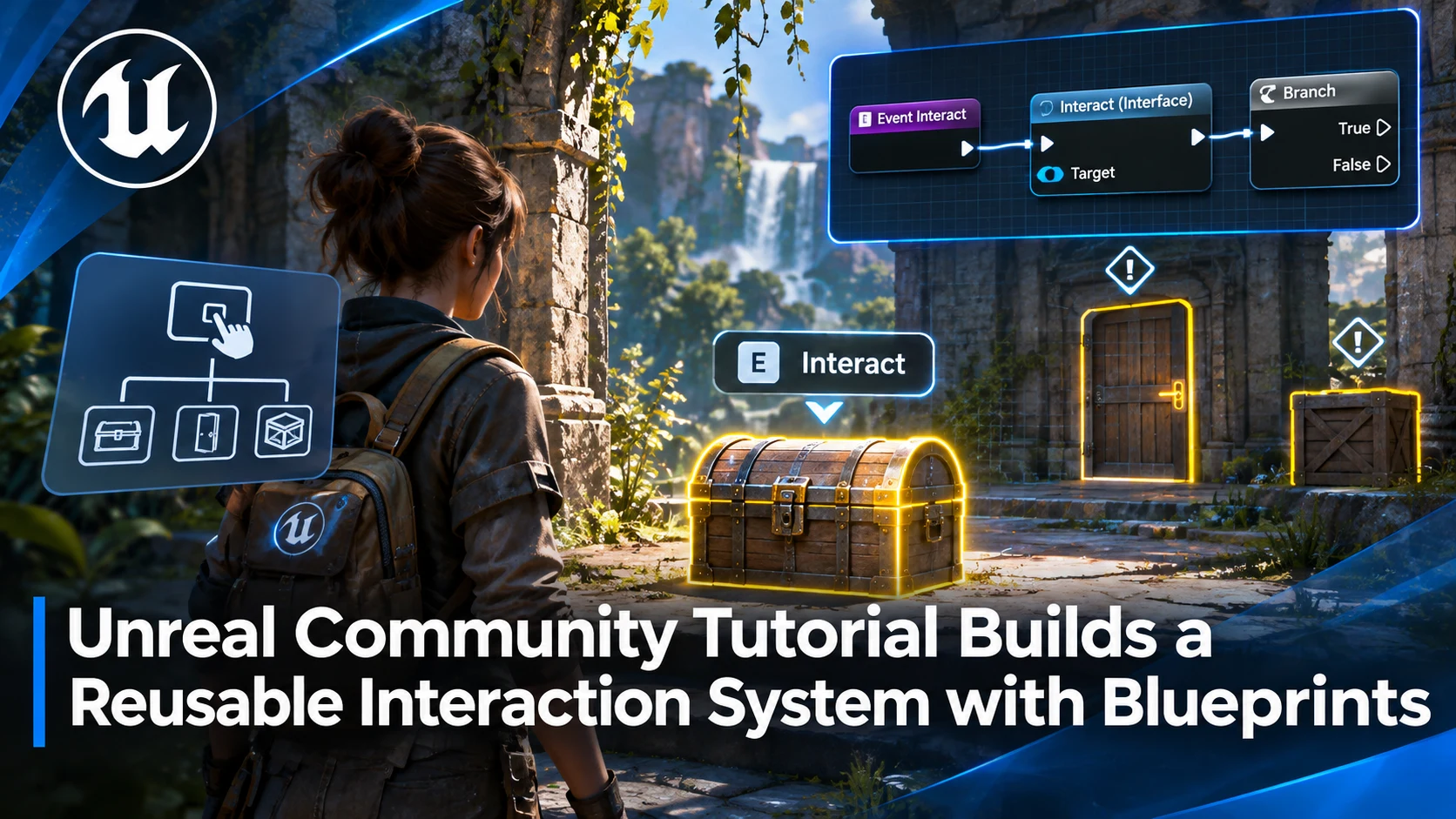
A newly published Unreal Engine community tutorial focuses on a small but consequential part of gameplay development: making different objects respond consistently when a player interacts with them. The lesson, titled Prototyping a Reusable Interaction System in Unreal Engine, appeared on November 12. It is an instructional resource by a community author, not an announcement of a new feature in an Unreal Engine release.
The underlying problem is familiar in first-person and third-person games. A player may need to open doors, collect supplies, inspect equipment and activate switches. Creating a separate detection and input implementation for every object is possible, but it makes changes harder to coordinate. The tutorial instead explores a camera-based line trace to identify a target and an input action to trigger the interaction. A Blueprint interface provides a shared point of communication between the player logic and different interactable actors.
Interfaces are useful because a player controller or character can ask whether a hit actor supports a particular interaction without treating every actor as a specific door or pickup class. The object remains responsible for what the interaction actually does. A door might animate, a pickup might add an item to inventory, and a control panel might change another actor's state. The article's importance is therefore architectural rather than visual: it presents a repeatable design pattern built from tools already available in Unreal.
This approach does not resolve every production concern automatically. A developer still needs to decide how interaction distance is calculated, what happens when several objects overlap, how accessibility prompts are displayed and which actions should be authoritative in multiplayer. Replication, permissions and save-game handling require separate decisions. The tutorial should not be mistaken for a complete network-ready interaction framework.
A practical exercise would be to prepare three test actors, such as a door, a collectible battery and a light switch, then give all three the same interface contract. The player can trace toward each actor and issue one shared input command. If each responds correctly without modifying the player's interaction logic, the reusable structure has served its purpose. The next useful measurement is how much additional code or Blueprint wiring is needed when a fourth object type is introduced.
Rate this story
What did you think of this article?
Log in to rate this story, comment and like replies.
Log inNo comments yet. Be the first to share your thoughts.
More stories
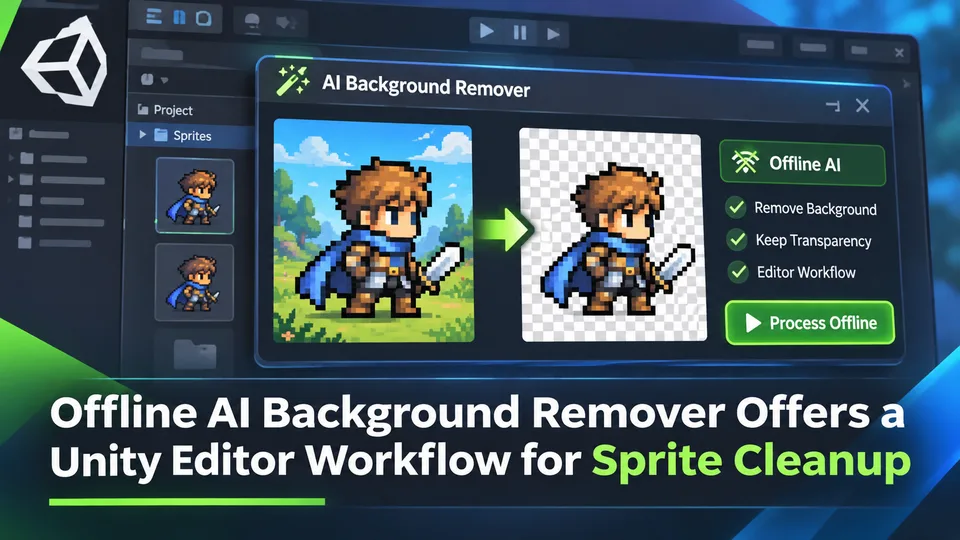
Offline AI Background Remover Offers a Unity Editor Workflow for Sprite Cleanup
A third-party Unity developer introduced an offline AI background remover for preparing transparent sprite images in the editor. It is a local content-authoring tool, not a runtime background-removal feature built into Unity.
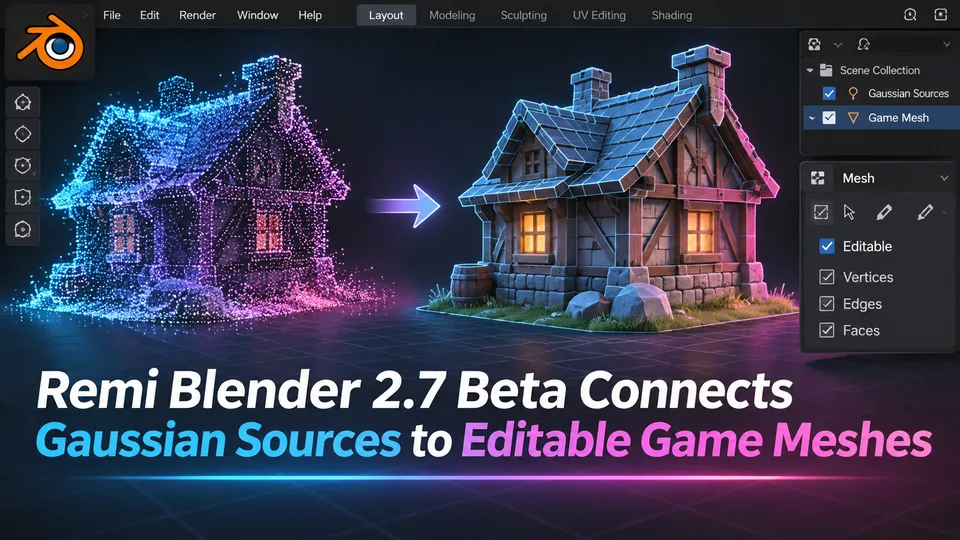
Remi Blender 2.7 Beta Connects Gaussian Sources to Editable Game Meshes
Remi Blender 2.7.0-beta.7 adds an Asset Board for image, Gaussian and mesh workflows, including texture transfer and native Blender editing. The prerelease has strict Windows and Blender requirements and relies on external AI components.
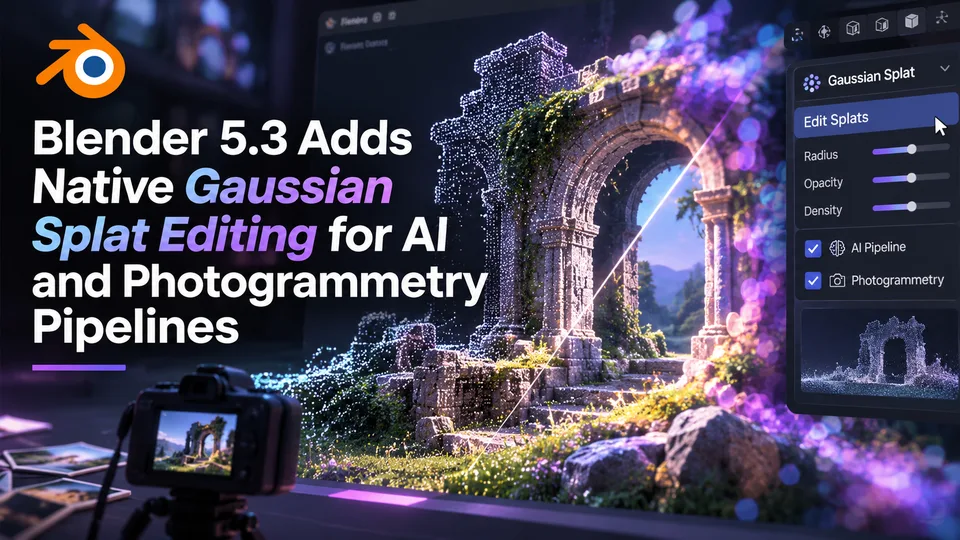
Blender 5.3 Adds Native Gaussian Splat Editing for AI and Photogrammetry Pipelines
Blender 5.3 was released on November 10 with native 3D Gaussian Splat importing, editing and rendering. The technology expands scene-capture workflows, but a splat is not automatically a game-ready polygon mesh.
Comments