
New Unreal Engine 5.8 Tutorial Introduces Runtime Plugin Development
A new community tutorial explores runtime plugins in Unreal Engine 5.8, offering a starting point for developers building reusable C++ gameplay systems.
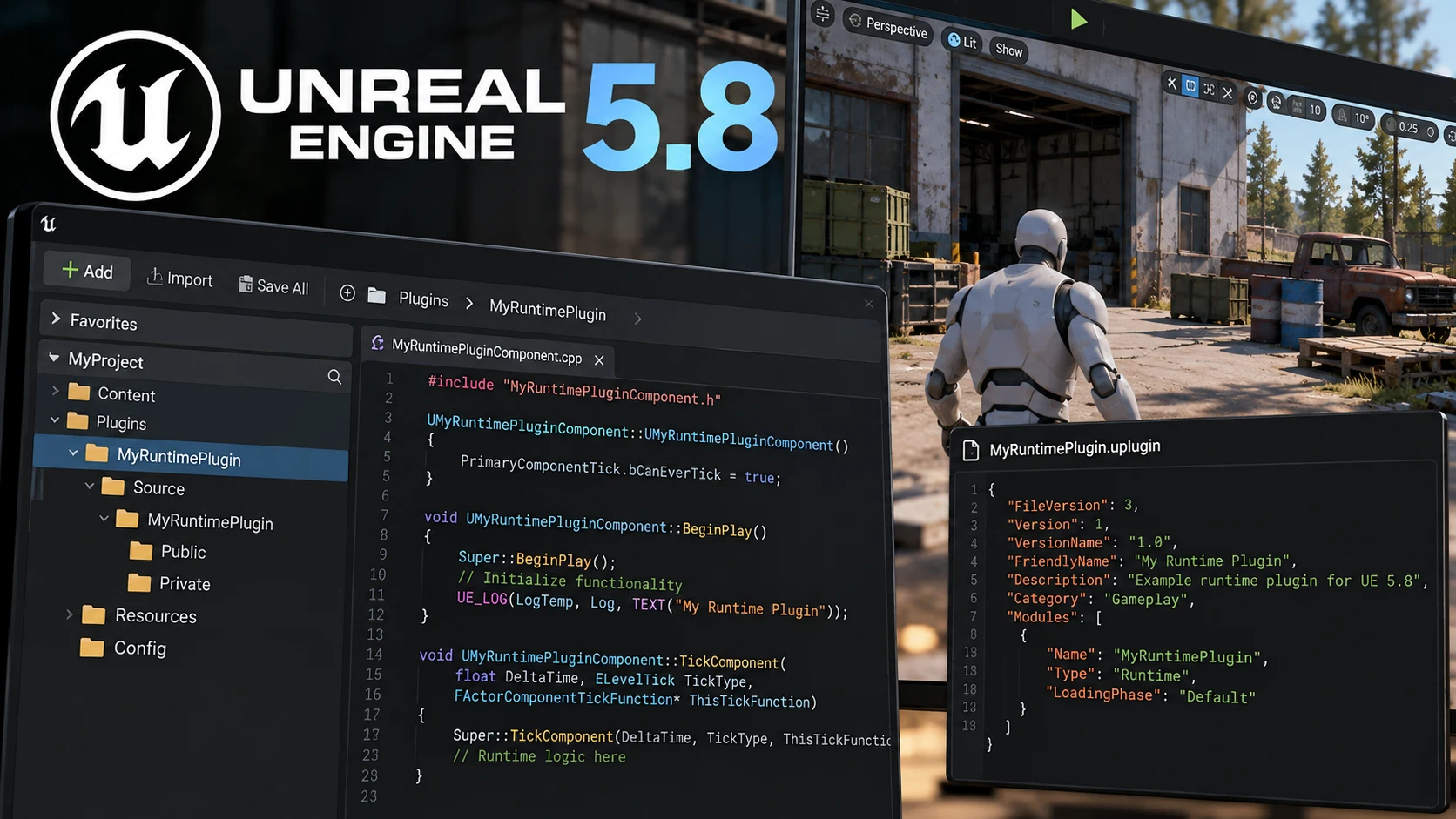
A new community tutorial listed on Epic Developer Community on October 28, 2026, introduces runtime plugin development in Unreal Engine 5.8. Titled Creating Your First Run-Time Plugin in Unreal Engine 5.8, the resource focuses on an approach worth understanding for developers who want to build systems they can use across multiple projects.
This is a learning resource rather than a new engine feature. Its relevance comes from a practical question: how should developers organize useful gameplay code so that their next game does not have to start from scratch?
In Unreal Engine, a plugin can contain code and, when configured to do so, its own assets. Developers can enable it within a project instead of placing all functionality directly inside that project’s main codebase. Plugins can introduce gameplay features or extend the editor without requiring changes to the engine’s source code.
The distinction between runtime and editor functionality is important. A runtime module is intended for features that operate while the game is running. An editor module is intended for tools used during development. A single plugin can contain both, with their responsibilities separated into appropriate modules.
For a small team, a useful first experiment might be a reusable health and damage system. Rather than rebuilding that behavior for every prototype, the team could place it in a plugin and expose configurable values for each game.
Imagine two projects: a survival game with enemies and destructible supplies, and a base-defense game with soldiers and buildings. Both might need objects that receive damage, track remaining health and trigger an event when destroyed. The shared plugin could provide those basic rules, while each project decides which sounds, animations or rewards accompany them.
The important design choice is what remains outside the shared system. A health component should not need to know the name of a particular level or depend on a specific enemy model. Keeping those decisions in the individual game would make the plugin easier to reuse and reduce the amount of unrelated content that must move with it.
For developers using AI coding assistants, this also suggests a more focused way to assign work. Instead of requesting an entire game framework, start with one small component, define its expected behavior and require a working demonstration. Ask for clear dependencies, readable implementation and a way to verify the result.
That is a suggested development approach, not a claim that the tutorial includes an AI integration or automated game-building system. The value lies in giving a programming task a clear boundary and a result that can be checked.
A practical evaluation should go beyond seeing the plugin appear in Unreal Editor. Our recommended first test would be to create a small scene, attach the new component to an object and confirm that its behavior matches the specification. Then repeat the test in a separate project to find any dependencies that were accidentally left behind.
Packaging deserves attention early. Unreal’s packaging process builds the project’s code and plugins for the target platform and prepares its content for use outside the editor. Testing that packaged application provides a separate check from running the scene inside Unreal Editor.
For the health-system example, the acceptance criteria could be straightforward: damage reduces health correctly, health does not fall below the intended minimum, destruction happens once, and the same behavior works after packaging. These are proposed checks rather than results from a plugin tested for this article.
The broader opportunity is to build a small library of dependable gameplay features instead of repeatedly copying unfinished systems between projects. Start with one component, prove that it works independently and expand only when another project creates a genuine need.
For creators developing several small games, that may be the most useful takeaway from learning runtime plugin development: the goal is not simply to create more code, but to make each proven system easier to use again.
Rate this story
What did you think of this article?
Log in to rate this story, comment and like replies.
Log inNo comments yet. Be the first to share your thoughts.
More stories

Epic Refreshes Mutable Sample for Unreal Engine 5.8
Epic's updated Mutable Sample demonstrates MetaHuman customization, clothing refitting and simpler character graphs, giving Unreal Engine developers a practical reference for building their own appearance systems.
UEFN Upgrades AI NPC Conversations With Eleven v4 Turbo
Epic Games has upgraded UEFN Conversations with faster voice responses, sentence streaming and improved character delivery, without requiring manual changes from creators.
Blender Live Link Brings One-Click Asset Transfers to Unreal Engine 5
Gamma Studio’s Blender Live Link connects Blender and Unreal Engine with one-click asset transfers, automatic updates, and support for models and animations.
Comments