
ClaudeUnreal 0.7.0 Adds Safer World Partition Automation
The third-party ClaudeUnreal plugin has added region-level World Partition commands and clearer reporting of failed editor actions. Its November 7 release notes also describe protections against unloading regions with unsaved edits.
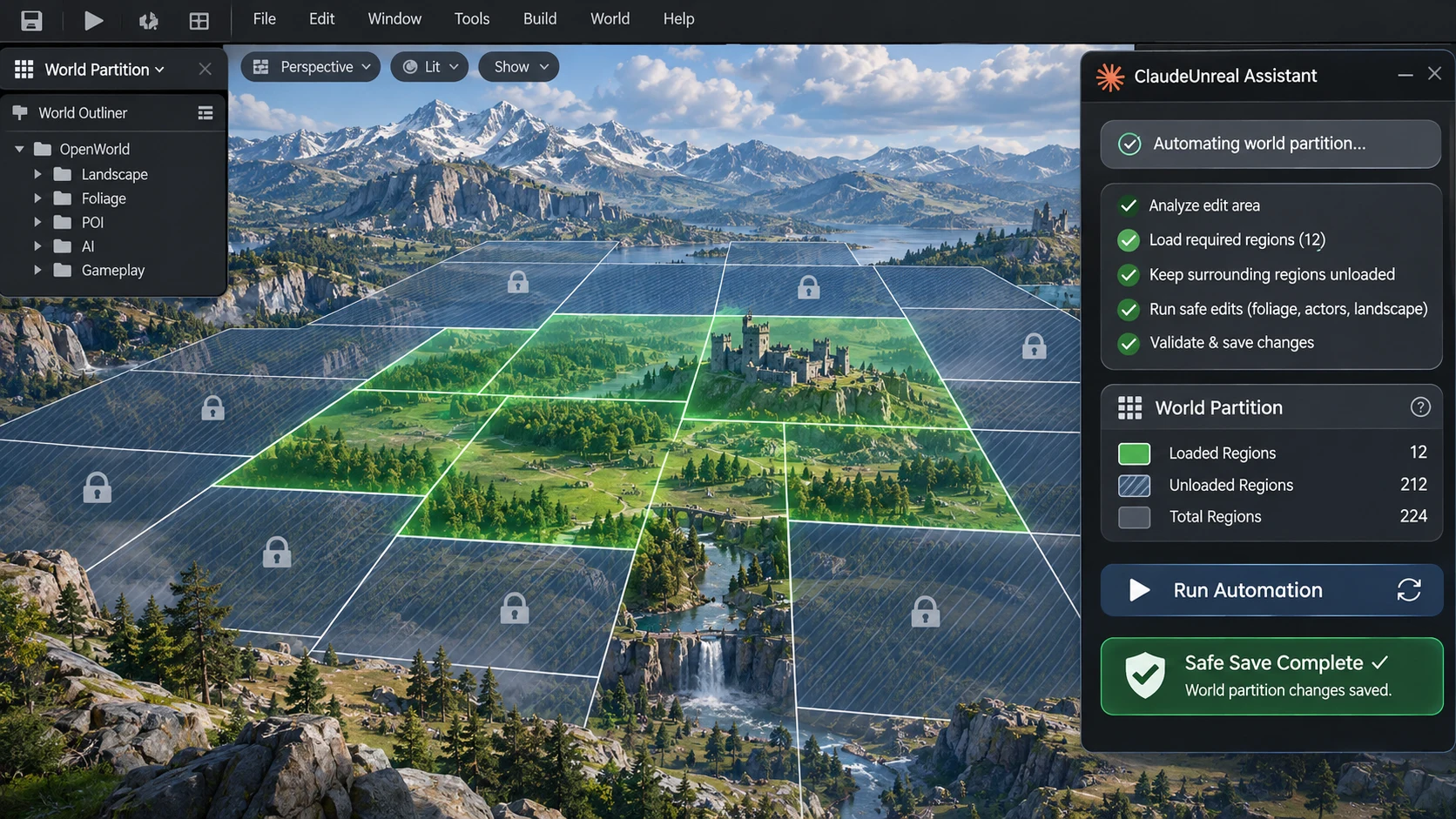
ClaudeUnreal's version 0.7.0 release notes, dated November 7, 2026, describe an update aimed at making AI-directed Unreal Editor work more observable and less likely to hide failures. ClaudeUnreal is a third-party product; it should not be confused with the first-party Experimental Unreal MCP plugin distributed by Epic. Both involve agentic workflows, but their implementation and support responsibilities are separate.
The most tangible change for large levels is a set of World Partition operations. The developer lists commands to load and unload a region, as well as a way to find actors that are not currently loaded. This matters because a large streamed world cannot always be edited sensibly as one fully loaded scene. Region-scoped actions offer a route to smaller, more controlled tasks such as changing vegetation or placing objects in a selected part of a landscape.
Safety depends on honest status reports. The release notes say commands now report what changed and whether an operation was actually successful, including whether a save wrote data or the editor raised an error. The tool also distinguishes an editor crash, a busy editor, and a command that may still be in progress. That distinction is important when an agent decides whether to retry an instruction: repeating a command that is still running could create duplicate actors or conflicting edits.
The update includes additional corrections involving landscape sculpting and painting on World Partition maps, HLOD building, and invalid targets for level creation. The developer states that unloading a region should refuse to discard unsaved changes. However, the notes specifically caution that actor counts in new command reports have not received intensive testing. These are vendor-reported changes rather than independent reliability measurements.
For a game with a multi-kilometer world, a sensible trial would begin in a cloned level. Ask the agent to find an unloaded actor, load a bounded region, make one reversible change, and save. Then deliberately leave another change unsaved and confirm whether unloading is blocked. Finally, inspect the Git diff or asset changes and repeat with the editor busy to see how failures are reported. The point is to validate the tool's guardrails before allowing it to modify a production map.
Rate this story
What did you think of this article?
Log in to rate this story, comment and like replies.
Log inNo comments yet. Be the first to share your thoughts.
More stories
Claude Code Adds Background MCP Tasks and Tighter Agent Permission Controls
Anthropic’s Claude Code 2.1.319 introduced asynchronous MCP tasks and new permission controls. These features may help game developers manage long-running Unreal or Unity tool operations without blocking every agent step.

ElevenLabs Releases a Unity SDK for Live Voice Conversations With NPCs
ElevenLabs has published a Unity SDK connecting scene characters to conversational voice agents. The developer documentation distinguishes supported desktop and WebGL targets from beta mobile and XR integration.

Unity MCP 1.10.0 Adds Screenshot Saving for Game Editor Agents
A community-maintained Unity MCP bridge has released version 1.10.0, adding an option for screenshot tools to save PNGs inside a project. The feature can support reviewable visual feedback when AI agents work on scenes.
Comments