
Voidless 6.4 Expands AI Rigging to Animals and Animated Props
Voidless version 6.4.0 adds automatic rigging for four-legged animals and movable props, while reducing stated rigging and custom-animation credit costs. Its exported GLB assets still need import and quality checks in Unity or Unreal.
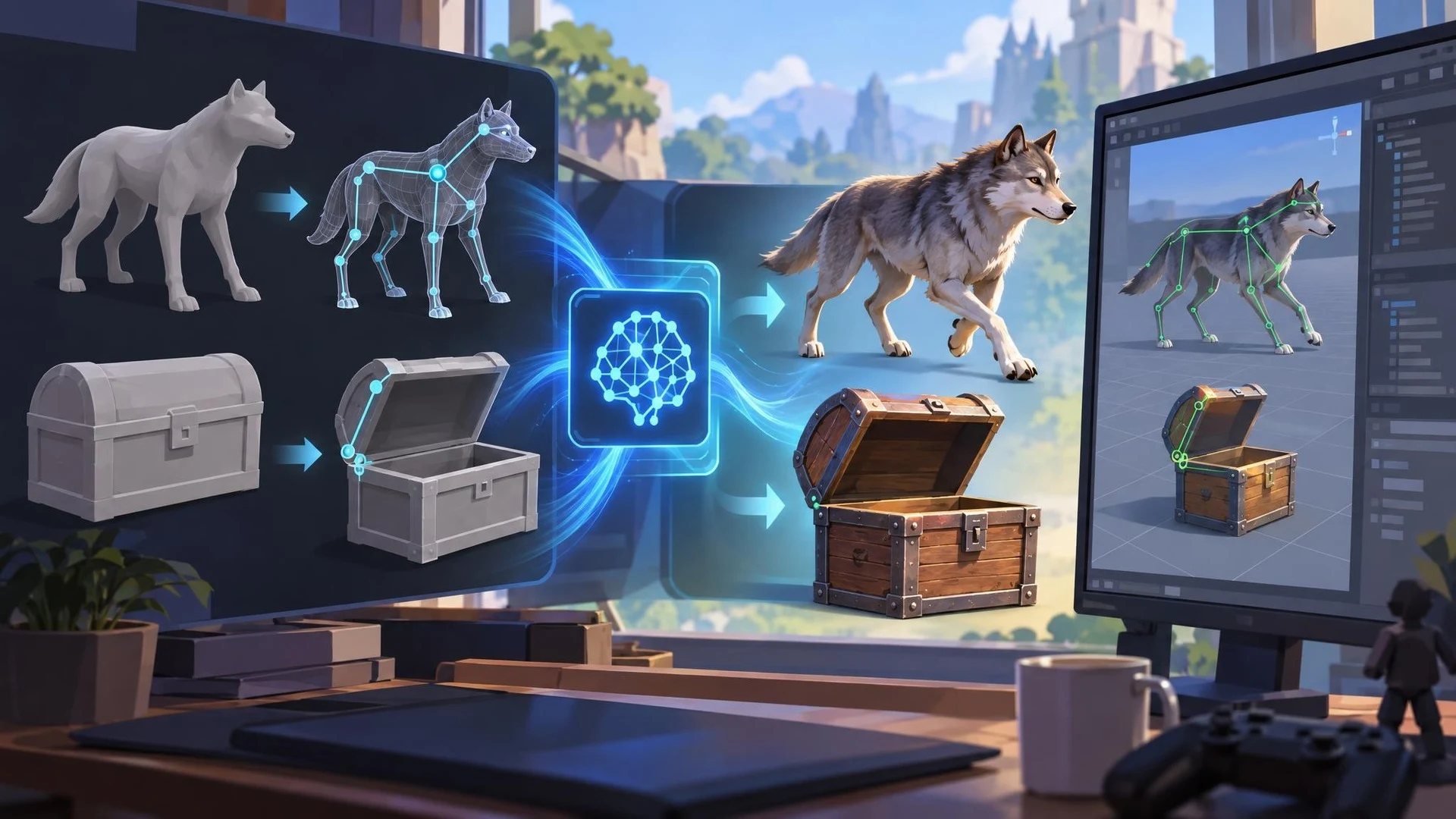
A character model is not necessarily ready to move. Animation requires a suitable skeleton, mesh binding, and motion clips that make sense for the object's proportions. Voidless announced version 6.4.0 on October 26, 2026, expanding its AI-assisted rigging workflow beyond conventional two-legged characters.
According to the company's release notes, Auto Rig now handles humanoid characters, four-legged animals, and props with moving parts. The examples include doors, chests, and tree trunks. The release also reduces the stated price of automatic rigging from 140 to 30 credits and described animations from 30 to 20 credits.
The company lists 12 ready-made actions for two-legged characters and eight for quadrupeds, available without an additional action charge after rigging. It also says a motion created for one rigged model can be copied onto another compatible model for free. These conditions do not make the initial model generation or every custom animation free.
For game creators, the potential value is a shorter route from a static asset to a first playable prototype. A creature used in an exploration game needs at least idle, walking, and attack or reaction motions before its role can be judged. Likewise, a mechanical prop needs a believable hinge or moving part to communicate interaction to the player.
The provider's current workflow supports downloadable GLB models and motions. Its documentation says Unity and Unreal users can import them through glTF tooling, which differs from a promise of native engine-specific assets with production-ready animation blueprints or controllers. Developers still need to inspect skeletal structure, animation timing, collision, and material conversion.
An informative test would use a simple four-legged creature and request a walking motion. Import the result into a disposable Unity or Unreal project, then evaluate whether the feet slide, joints bend plausibly, and the animation transitions cleanly. Repeat the test with a moving chest lid to see how the tool handles non-character anatomy.
Costs and availability should be checked at the time of use. Credits, plan restrictions, and commercial rights are controlled by the service's current policies. The company's marketing descriptions do not establish independent animation quality or a fixed success rate across arbitrary user models.
Voidless 6.4 is notable because it broadens an asset-preparation task that often requires specialist work. For small teams, it may be useful for early content experiments, provided the exported rig and motion are validated inside the actual game engine.
Rate this story
What did you think of this article?
Log in to rate this story, comment and like replies.
Log inNo comments yet. Be the first to share your thoughts.
More stories

OpenAI Python SDK 3.42.0 Adds Agent Session and Context Controls
The official OpenAI Python SDK release dated October 31 adds agent context compaction settings, session review controls and image-edit overlays. Developers building game-production automation can evaluate these interfaces, but they do not constitute a Unity or Unreal plugin.

Quibbler Adds MCP-Based Code Review for Codex and Cursor
Quibbler 0.3.1, released October 31, introduces an MCP mode so compatible coding agents can request synchronous reviews after editing code. The open-source release extends a previously Claude-oriented workflow, but needs testing in real repositories.

GitHub Copilot Makes Local Sandboxes Generally Available in JetBrains IDEs
GitHub’s October 28 JetBrains update makes local Copilot sandboxes generally available and adds next-edit suggestions. The security controls are especially relevant to AI agents editing Unity C# or Unreal C++ repositories in Rider and other supported IDEs.
Comments