
UE5.8 Materials Masterclass Adds a Security-Camera Post-Process Lesson
A new community lesson in an Unreal Engine 5.8 materials series demonstrates the creation of a gritty security-camera image effect with a post-process material.
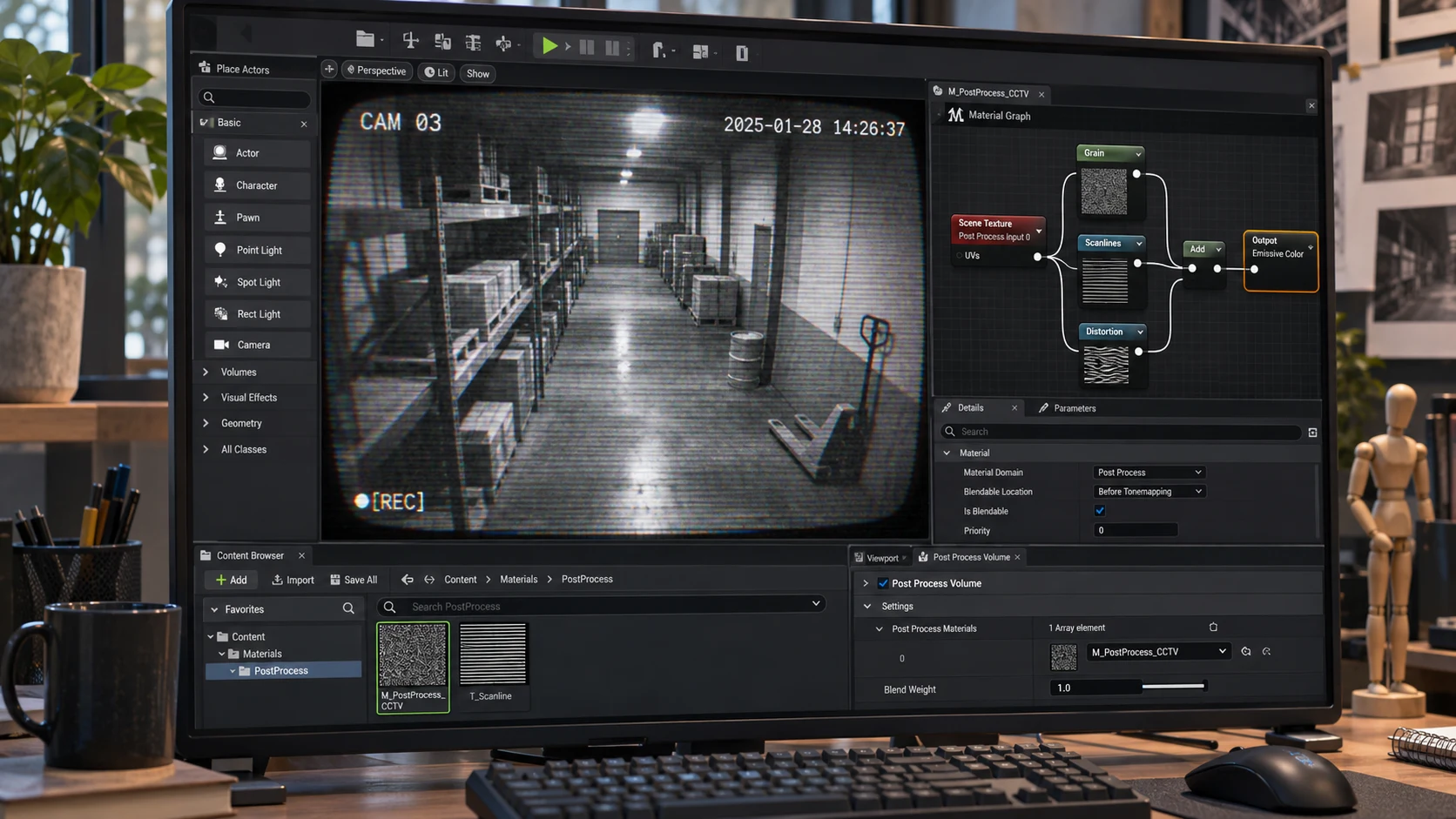
An Unreal Engine 5.8 materials masterclass received a new lesson on November 7, covering post-process materials through the example of a gritty security-camera filter. The resource appears in the Epic Developer Community and is credited to MargraveUnreal. It is an educational installment, not an announcement of a new rendering feature.
Post-process materials operate on the image after much of a scene has been rendered. For game developers, they can help communicate a specific visual perspective without rebuilding the underlying geometry or lighting. A security camera view might use altered color, grain, contrast or other screen-space treatments to feel separate from the player's normal perspective.
The tutorial is described as the first part of a two-episode look at post-process materials. Its stated practical target is the security-camera effect, making it a focused introduction for teams that want a recognizable visual outcome. The source does not establish that every possible security-camera feature, such as surveillance recording or network transmission, is included. Those are separate gameplay systems.
The technique is useful in stealth games, survival horror, investigation scenes and interfaces that show multiple camera feeds. A developer might show one fixed camera during a mission, transition to a monochrome feed, then return to a conventional viewport. The look can do narrative work, but it also creates accessibility and performance questions. Grain, flicker and extreme contrast should be adjustable when they impair legibility or player comfort, particularly in VR.
A practical experiment is to create a basic room, place a second camera actor and render its image to a display in the level. Apply the tutorial-inspired post-process effect only to that feed, and compare it with an untouched version. Test moving objects, emissive surfaces and bright-to-dark transitions. Measure render-target and post-processing overhead separately, because a second camera may add far more cost than the filter itself.
For publishing accuracy, this lesson should be presented as community training for Unreal Engine 5.8. It does not prove the introduction of a new post-process pipeline or a universal performance benefit.
Rate this story
What did you think of this article?
Log in to rate this story, comment and like replies.
Log inNo comments yet. Be the first to share your thoughts.
More stories
Unity Pipeline 1.0.0-pre.1 Adds CLI Profiler Analysis and Scene Previews
Unity promoted a prerelease of its Pipeline package with saved Profiler analysis, scene-preview archives and clearer command effects. This is an official pre-1.0 tool update with compatibility changes.
Niagara Fire Tutorial Explores Blackbody Shading and Curl Noise
A newly published community lesson builds a stylized Unreal Engine fire effect from material nodes and Niagara particles. It explains familiar techniques rather than introducing new UE5.8 functionality.

New Community Walkthrough Covers Avatar Image Optimization for Unreal Services
A recent Unreal community tutorial demonstrates resampling avatar images, converting textures to WebP and moving files through Blueprint-backed cloud workflows. It is a third-party tutorial, not an Epic engine feature.
Comments