
New Unity Enemy AI Guide Focuses on Fair Behavior and Readable Attacks
Unity has published a beginner-friendly guide to non-generative enemy AI, including state machines, sensory detection, attack telegraphs and boss phases. The practical value lies in designing understandable opponents rather than adopting a newly released AI package.
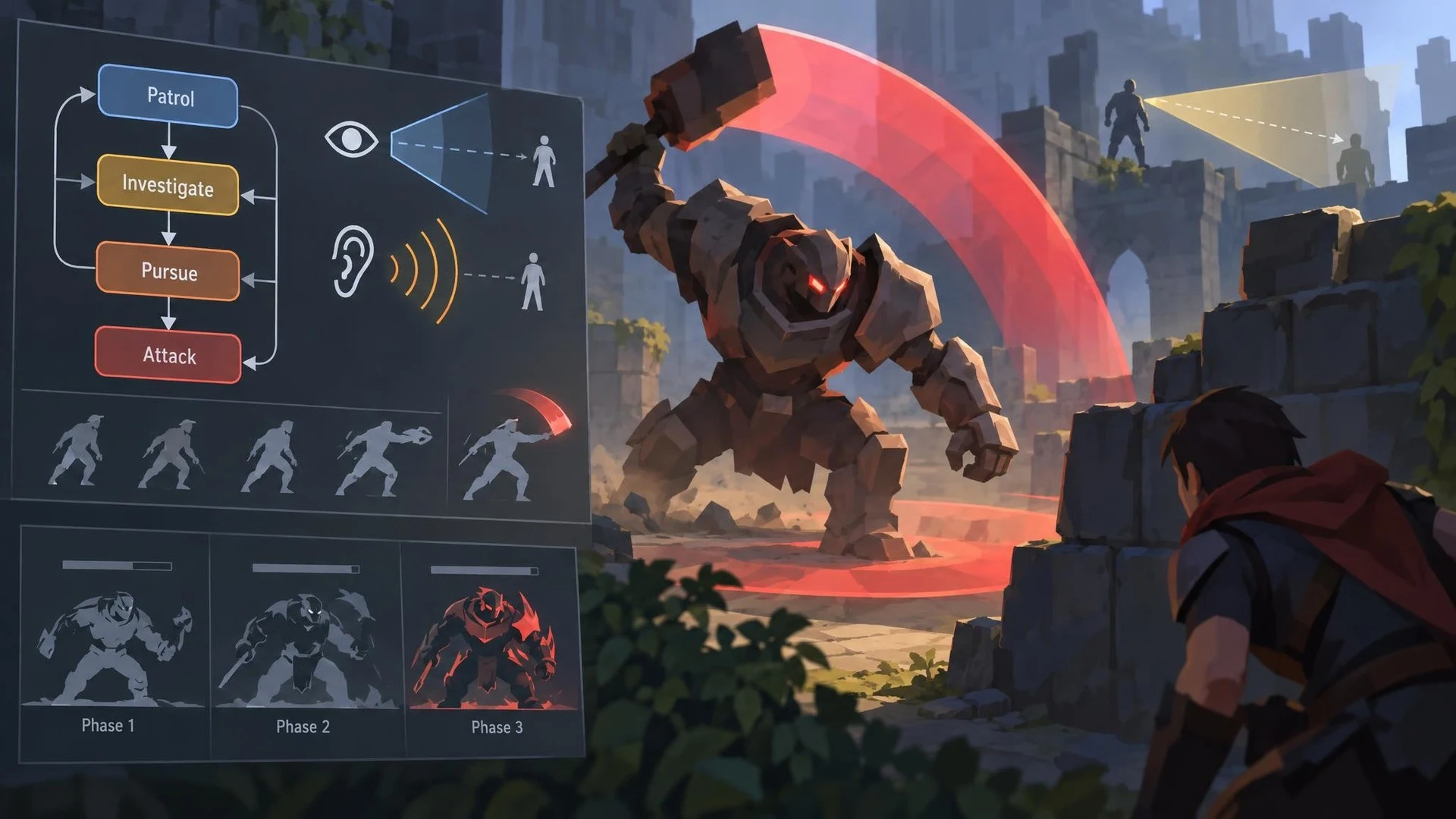
When a game enemy reacts in a believable way, players may describe it as intelligent even if its decisions are controlled by a fairly small set of rules. Unity's October 27, 2026 guide explains the design behind that illusion, covering patrol states, awareness, attack warnings, and boss encounters. It is an educational article, not a new enemy AI framework in the engine.
The guide starts with the common idea of behavior states. An enemy can patrol, become suspicious, investigate a noise, attack a visible target, or retreat. Each state defines what the character is trying to do, while transitions explain when that behavior changes. This structure is attractive for small games because developers can inspect and test decisions without needing an opaque learning model.
Perception gives those states a reason to change. A simplified vision cone, a line-of-sight test, and a hearing radius can produce a convincing guard. Yet perfect physical realism is not necessarily the goal. A character that notices a player through an ambiguous gap might technically follow its detection rules while still feeling unfair. Game designers should consider whether the player can understand why detection happened.
Unity also discusses decision methods that go beyond rigid state transitions. A priority-based system can check important conditions in order, while a scoring system weighs possible actions according to health, distance, or resources. Such systems offer different trade-offs between simplicity, predictability, and variety. More elaborate logic is not automatically better gameplay.
Combat readability is another essential concern. Attack telegraphs provide visual, audio, or animation cues before a dangerous event. An enemy that clearly prepares a heavy swing gives players an opportunity to dodge or block. Without that warning, a perfectly functioning damage system can still feel arbitrary. Boss phases use similar principles, introducing new challenges while preserving understandable patterns.
A practical prototype could involve a single enemy with four states: patrol, investigate, pursue, and attack. Add a visible debug indicator for its current state, then test detection from behind walls, at the edge of its vision, and in response to footsteps. Give its attack a short readable wind-up and let unfamiliar testers report whether they understood the cause of each reaction.
This topic is different from a conversational language model generating NPC dialogue. Conventional game AI controls behavior through defined logic and gameplay constraints. Generative systems may add new possibilities, but they do not replace clear rules for collision, timing, and player feedback.
Unity's guide is most useful as a reminder that convincing enemies are designed around the player's experience. Their decisions should be testable, legible, and consistent enough to support learning, even when some randomness is deliberately added.
Rate this story
What did you think of this article?
Log in to rate this story, comment and like replies.
Log inNo comments yet. Be the first to share your thoughts.
More stories

Community Unreal Engine 5.8 WebGPU Fork Shows Browser-to-Native Multiplayer
A community developer has demonstrated a modified Unreal Engine 5.8 build running through WebGPU in a browser alongside a native macOS multiplayer client. The project remains experimental, and its author explicitly says it is not yet production-ready.
UStudio Brings Unreal Blueprint Inspection and Local MCP Tools to VS Code
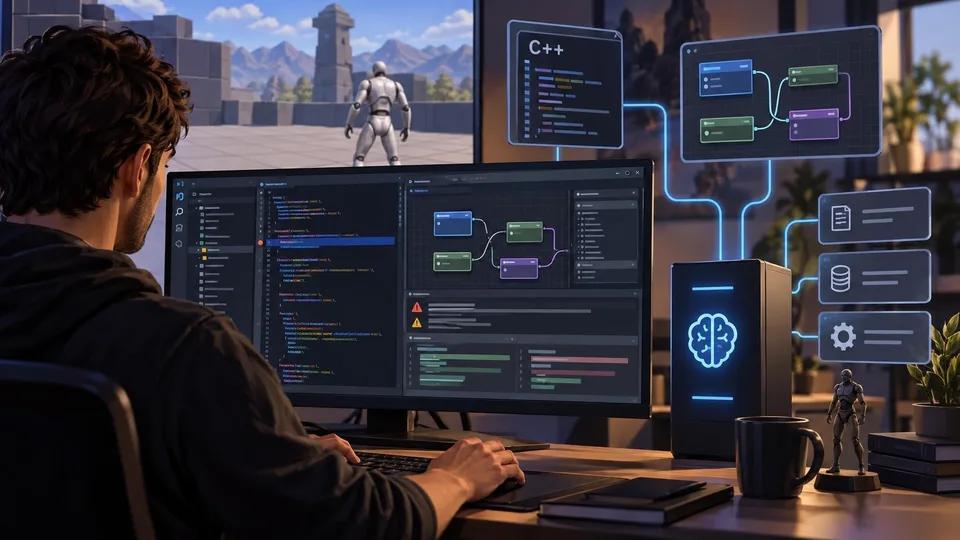
The developer of UStudio has introduced a VS Code and Cursor extension with Unreal-specific C++ inspection, Blueprint viewing, live execution feedback, and a local MCP server. These capabilities are product claims that still require independent project testing.

Unity 6.3 LTS Patch 6000.3.27f2 Fixes Security and Import Problems
Unity published editor build 6000.3.27f2 on October 30, addressing a Brotli decoder vulnerability alongside model-import, rendering and stability issues. Studios should assess the security fixes while testing the patch against their own projects before broad deployment.
Comments