
New UE5 Niagara Lesson Illustrates Liquid Flow from a Moving Hose
A November 8 community lesson describes a moving-hose effect using Niagara Grid 3D liquid, a tube-shaped ribbon and Particle Attribute Reader. It explains a workflow rather than introducing a new engine component.
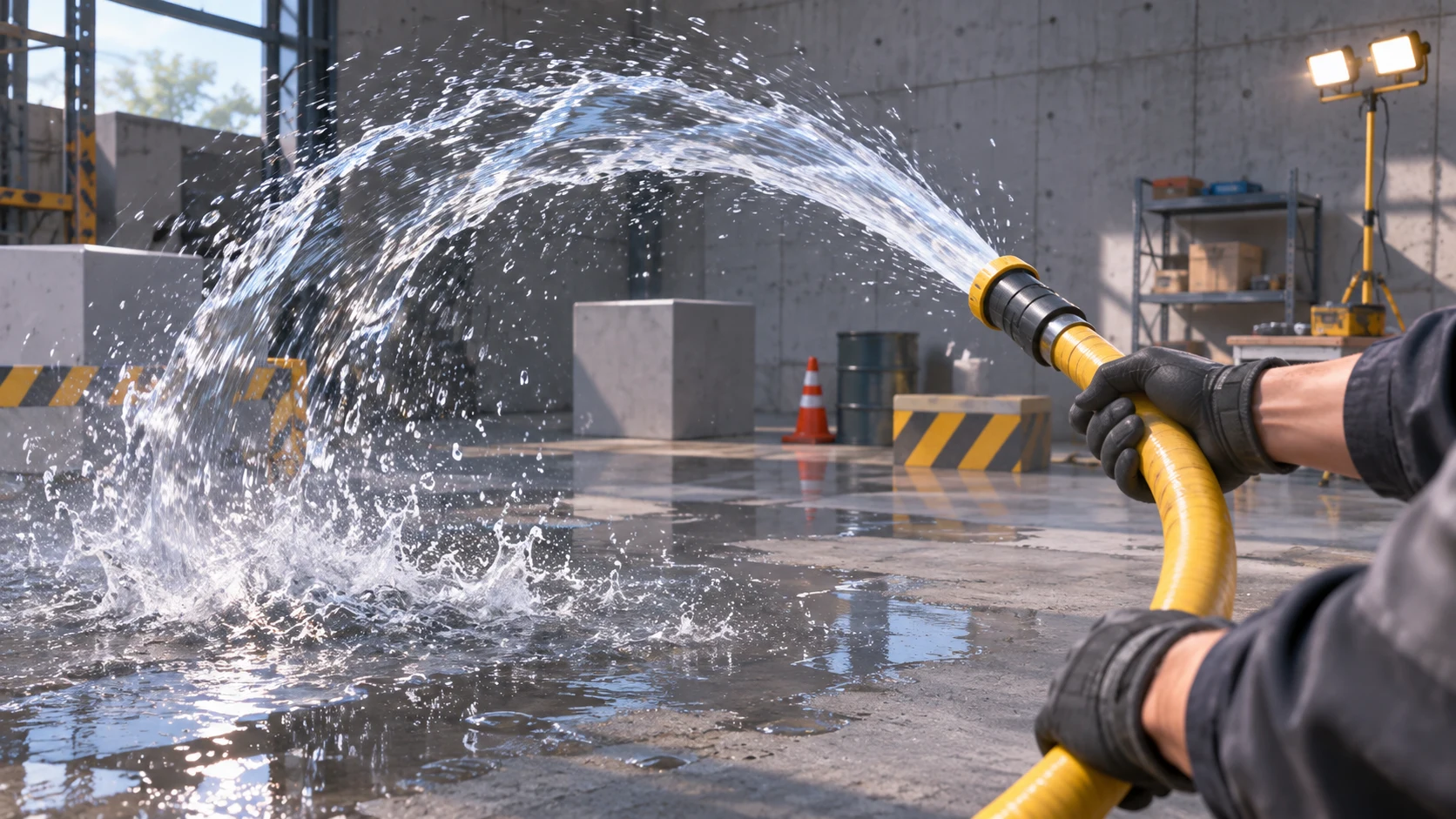
Effects attached to moving equipment must follow their source convincingly. A water jet that appears to detach from a hose or a spray that lags behind the nozzle can break the illusion even if the individual particles look realistic. A newly published Unreal Engine 5 community tutorial concentrates on this emitter-following problem.
The November 8 lesson, available on the Epic Developer Community in translated form, describes a liquid effect from a moving hose or pipe. The workflow combines Niagara Grid 3D liquid simulation with a tube-like ribbon influenced by curl noise. The central connection uses Particle Attribute Reader to align the emission location with the moving end of the hose.
This is not an announcement of a new Niagara feature. It is a specific example of coordinating a moving visual source with a fluid simulation. That coordination is useful beyond a hose: a similar design question appears in industrial equipment, vehicle exhaust, fuel leaks or interactive maintenance mechanics. The details of the setup will differ depending on what emits the effect and how its position is tracked.
For a practical evaluation, start with a simple animated pipe in an otherwise empty scene. Move the nozzle slowly, then quickly, and observe whether the effect remains attached in both cases. Add a sharp direction change, pause the motion and restart it. This will help reveal visual discontinuities before introducing expensive materials or more complex collision geometry.
Once the source-following behavior works, investigate simulation bounds, camera distance and performance. A full Grid 3D liquid effect may be appropriate for an important close-up and excessive for a small distant spray. Niagara's runtime behavior should be profiled on the game's target hardware, especially if multiple hoses or fluid sources can run simultaneously.
The community lesson offers an illustration of the mechanics involved, not benchmark results or a production-ready hose simulation for every game. Its value is the clear problem it addresses: keeping a generated visual effect connected to a changing source location while preserving convincing motion.
Rate this story
What did you think of this article?
Log in to rate this story, comment and like replies.
Log inNo comments yet. Be the first to share your thoughts.
More stories
Unity Pipeline 1.0.0-pre.1 Adds CLI Profiler Analysis and Scene Previews
Unity promoted a prerelease of its Pipeline package with saved Profiler analysis, scene-preview archives and clearer command effects. This is an official pre-1.0 tool update with compatibility changes.

Niagara Fire Tutorial Explores Blackbody Shading and Curl Noise
A newly published community lesson builds a stylized Unreal Engine fire effect from material nodes and Niagara particles. It explains familiar techniques rather than introducing new UE5.8 functionality.

New Community Walkthrough Covers Avatar Image Optimization for Unreal Services
A recent Unreal community tutorial demonstrates resampling avatar images, converting textures to WebP and moving files through Blueprint-backed cloud workflows. It is a third-party tutorial, not an Epic engine feature.
Comments