
ForgeMind Reports New Unreal MCP Blueprint and Material Test Milestones
ForgeMind’s developer reports 72 passing Blueprint cases out of 73 and initial Material-domain tests across Unreal Engine 5.0–5.8. The figures are author-reported development progress, not independent proof that the MCP automation works in every production project.
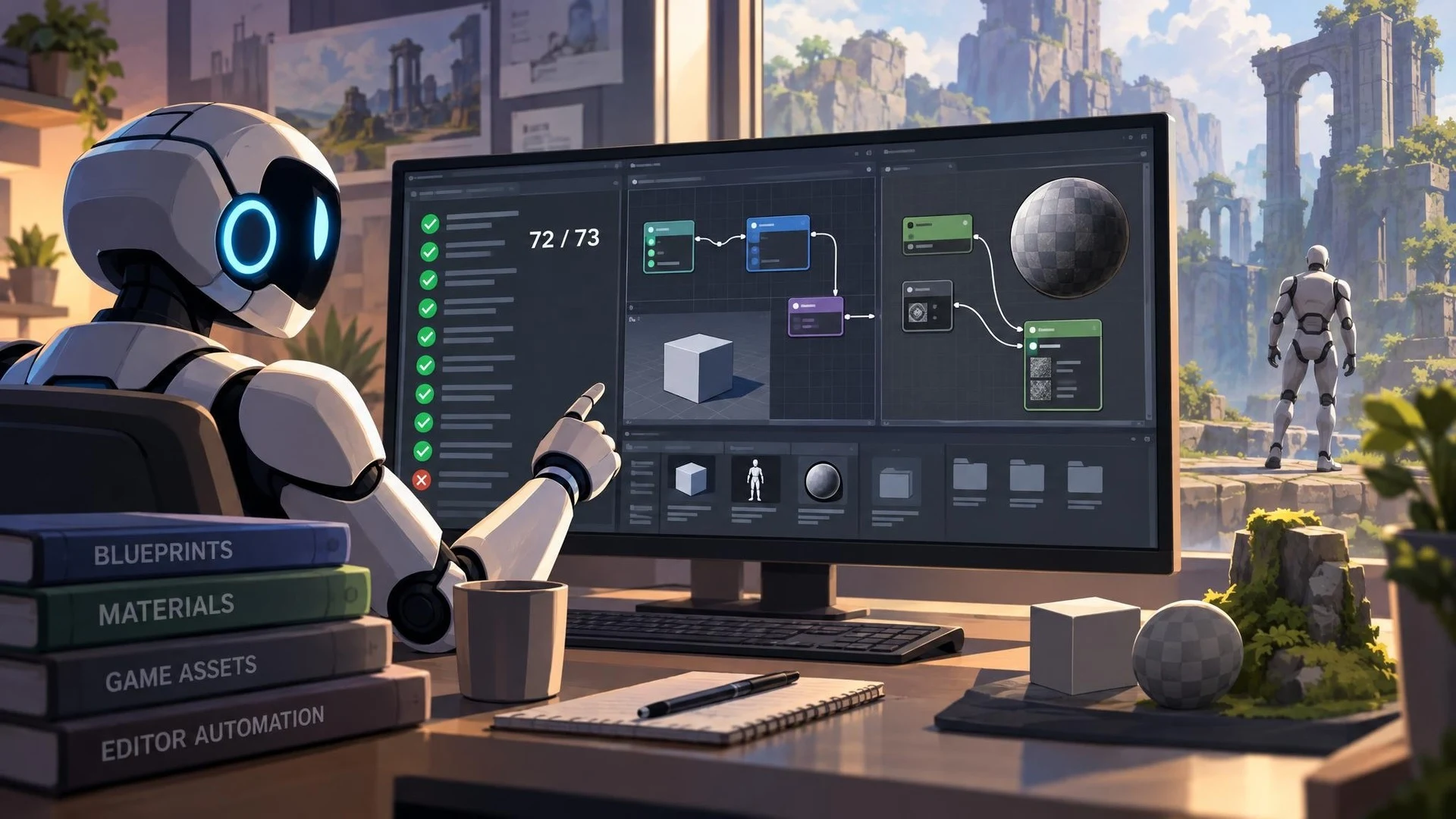
AI agents that control a game editor need more than the ability to describe code. To be useful, they should create real assets, detect errors, and leave changes that a developer can inspect. A community project called ForgeMind has published an October 30, 2026 progress report describing its Model Context Protocol integration with Unreal Engine.
The author says ForgeMind can locate and validate projects, communicate with a running Unreal Editor, inspect some asset content offline, and generate editor assets from a declarative representation. In this approach, an AI assistant could request a structured operation that produces a real Blueprint or material rather than simply writing text about what the user should build.
The latest report focuses on test coverage. The developer states that 72 out of 73 Blueprint cases now pass across actual Unreal Engine 5.0 through 5.8 projects. The remaining case is described as an in-progress runtime component task. Work has also begun on the material domain, with five initial cases addressing operations such as constants, comparisons, conditional expressions, and scalar parameters.
These numbers are useful as milestones, but they require careful interpretation. A passing case in the project's own test suite demonstrates the behavior under a specific test setup; it does not establish compatibility with every installed plugin, custom project type, or Unreal Engine build. There is no independent benchmark in the announcement confirming the claims at production scale.
Editor automation can be particularly valuable for repetitive asset setup. A developer may want to generate several similar Blueprint actors, connect basic material nodes, or inspect dependencies before making changes. Yet the risk of an automation error grows when the agent can modify a large repository. It is important to know exactly which actions are available and how their effects are verified.
A safe first test would use an empty Unreal project in source control. Ask the tool to create one simple Blueprint with a visible property and a basic material with a scalar parameter. Reopen the assets manually, compile the Blueprint, and test the material in a scene. Then compare the actual generated assets with the requested specification and review the version-control differences.
Before allowing broad writes, teams should verify how the MCP server authenticates, which directories and editor projects it can access, and whether potentially destructive actions require confirmation. A test suite passing on the author's machine is not a substitute for project-specific boundaries.
ForgeMind is an independent open-source automation effort, not an official Epic release. Its recent update offers evidence of continuing development toward more complete editor control, while reminding developers that dependable AI workflows require observable results and reproducible tests.
Rate this story
What did you think of this article?
Log in to rate this story, comment and like replies.
Log inNo comments yet. Be the first to share your thoughts.
More stories
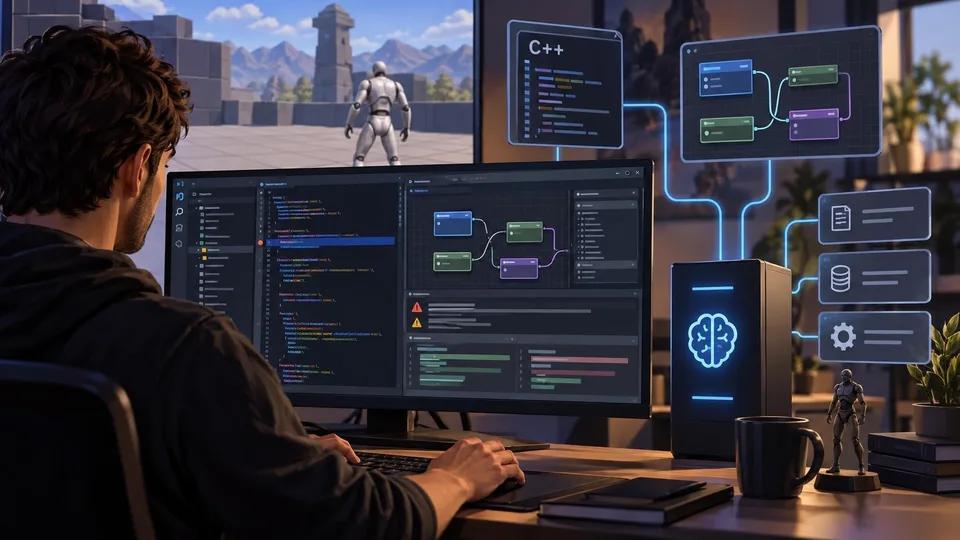
UStudio Brings Unreal Blueprint Inspection and Local MCP Tools to VS Code
The developer of UStudio has introduced a VS Code and Cursor extension with Unreal-specific C++ inspection, Blueprint viewing, live execution feedback, and a local MCP server. These capabilities are product claims that still require independent project testing.

Atelico Opens Early Access to Local AI Engine for Game Characters
Atelico has opened early access to an on-device AI engine that advertises integrations with Unreal Engine, Unity and Godot. It aims to support dialogue, memory, speech and generated content without per-token cloud calls, but its performance claims need testing.

Claude Code 2.1.316 Adds Subagent Effort Controls and Shell Process Fixes
Anthropic released Claude Code 2.1.316 on October 31 with a configurable default effort level for subagents and fixes for commands left running after certain exits. The changes address supervision of automated workflows rather than gameplay features.
Comments