
Epic Previews Cesium, Mesh Terrain and Unreal MCP Demos for I/ITSEC 2026
Epic Games has outlined its Unreal Engine 5.8 simulation showcase for I/ITSEC in Orlando. The announced demonstrations cover geospatial visualization, experimental Mesh Terrain, procedural worlds and AI assistants connected through Unreal MCP.

Epic Games has announced what its Unreal Engine team plans to demonstrate at I/ITSEC 2026, the modeling, simulation and training conference scheduled for November 30 through December 3 in Orlando. The November 4 announcement focuses on how Unreal Engine 5.8 can combine real-world geographic information, procedural worldbuilding and AI-assisted development. It is a preview of planned conference demonstrations, not a newly released engine update.
Epic will share booth space with Cesium. The company highlights vector tiles, geospatial stylization and three-dimensional Gaussian splatting with levels of detail as areas visitors can explore in Cesium for Unreal. These workflows are relevant to developers who want to bring geographic areas into interactive simulations without modeling every surface manually. Their actual performance and suitability for a particular project still depend on data sources, hardware and implementation.
Another scheduled demonstration concerns Unreal Engine 5.8's experimental Mesh Terrain system. Unlike a conventional heightmap, a mesh-based terrain representation can support vertical shapes such as cliffs, tunnels and overhangs. Those possibilities are attractive for survival games and simulation environments, but the experimental label matters. Teams should verify tooling stability and performance before adopting the workflow for a production world.
Epic also plans to discuss Unreal MCP, the embedded Model Context Protocol server that enables compatible coding assistants to interact with Unreal Editor. The examples named by the company include AI-assisted geospatial exploration and a GPU-accelerated LiDAR sensor simulation. These are specific applications built with AI-assisted development; they do not imply that a language model automatically creates a complete validated simulation on demand.
Procedural Content Generation is another part of the presentation. Epic references its Electric Dreams and City Sample demonstrations to show how rules can assist with placing large amounts of world content. Developers interested in this approach should distinguish editor-time generation from procedural systems that must update during gameplay.
A practical evaluation could begin with a small real-world area, one mesh-terrain section and a repeatable PCG placement rule. Record import time, memory consumption and frame-time before adding AI-based editor automation. The result would be much more informative than judging only a promotional screenshot.
The announcement is valuable because it identifies where Epic is investing demonstration effort. It does not establish release dates for additional features, guarantee cross-platform behavior or replace the need to test experimental systems on target devices.
Rate this story
What did you think of this article?
Log in to rate this story, comment and like replies.
Log inNo comments yet. Be the first to share your thoughts.
More stories
Fortnite Ecosystem 43.00 Brings PCG and New MCP Tools to UEFN
Epic has released Fortnite Ecosystem 43.00 with editor-time PCG, new UEFN MCP capabilities and a production-ready quest Progression API. The changes apply to the Fortnite creator environment, not automatically to conventional Unreal Engine projects.

Epic Marks Unreal Engine 5.8 Garbage Collection Regression Fixed for 5.8.5
An Epic forum bug-report update says a reported Unreal Engine 5.8 garbage collection slowdown is resolved internally and scheduled for the 5.8.5 hotfix. Developers should not confuse the future fix designation with a patch already installed.
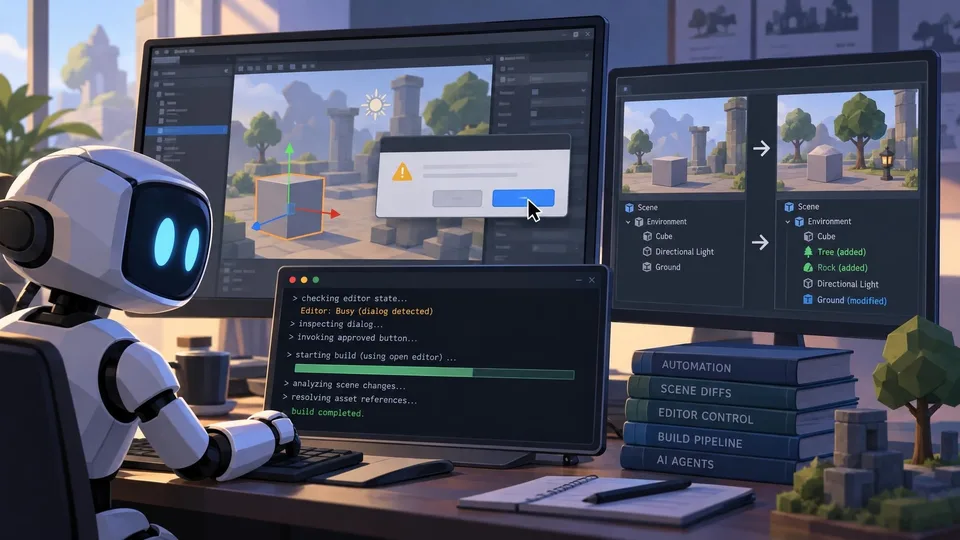
Unity CLI Beta 16 Adds Editor Dialog Control and Object-Level Scene Diffs
Unity CLI 1.0.0-beta.16 gives automation tools better visibility into blocked Editor dialogs and detailed scene changes. It also supports building through an open Editor and updating Unity-specific skills for coding agents.
Comments