
World Forger 1.0 Brings Seed-Based Procedural Villages to Unity
World Forger 1.0 is a third-party Unity tool for assembling roads, houses and settlement details using editable placement rules. Its developer says generation works both in the Editor and at runtime, with Unity 6.3 LTS or newer required.
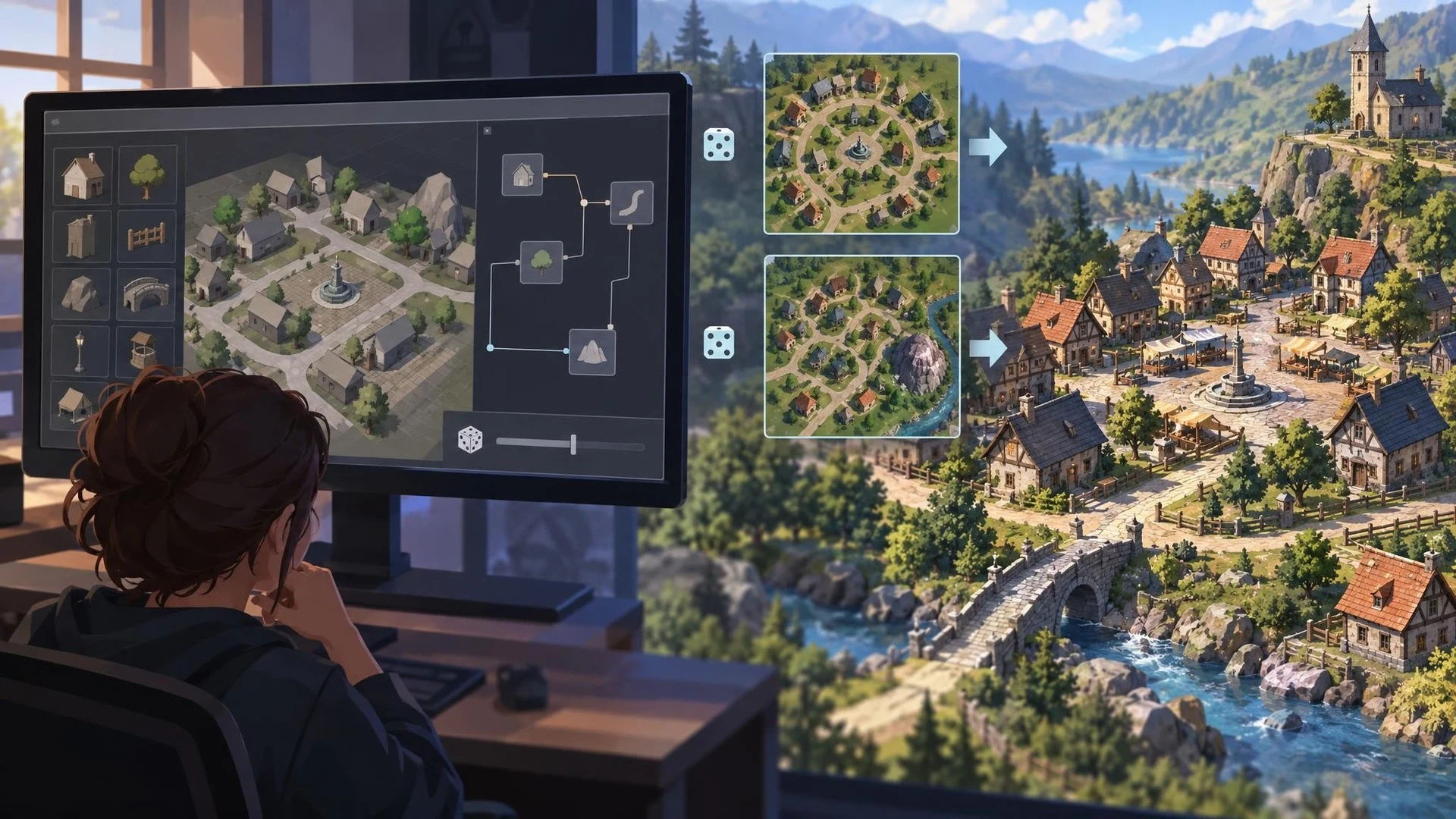
A village is more than a group of houses placed randomly on terrain. Roads need to connect, buildings need room, and the layout must leave space for paths, landmarks and gameplay. A third-party Unity Asset Store release dated October 30, 2026 aims to automate part of that process. Its name is World Forger 1.0.
The developer describes a rule-driven system in which artists create a Stencil using nodes, prefab selections and spawning filters. A Forger component turns those definitions into scene geometry. Using the same seed should reproduce the same layout, while changing the seed creates variation under the same design rules. That repeatability can be useful for testing procedural levels and comparing player navigation across generated layouts.
World Forger includes a dedicated village generator that the creator says supports 42 road arrangements, residential areas, a central square and placement around obstacles. The package also contains a more general prefab-scattering tool and experimental components for countryside, roads, streams and bridges. Those experimental elements should be treated as less mature than the main release. A medieval art kit with 475 prefabs and sample scenes is included, while other showcase art packs are separate purchases.
The product is not limited to precomputing content inside Unity Editor. Its developer advertises a runtime API for constructing settlements while a game is running. That capability changes the performance question: a tool that produces an attractive village in the Editor might require careful loading, generation scheduling, navigation updates and memory budgeting when used during gameplay. The stated support covers Unity 6.3 LTS and later, with Unity Splines required for village and certain experimental features.
A practical test could begin with a small empty terrain and one set of owned building prefabs. Generate the same village twice with an identical seed, compare its object hierarchy and road geometry, then change the seed and review how roads and placement behave around a deliberately placed obstacle. Next, measure runtime generation cost and collision setup before relying on it during play.
World Forger is an independent vendor tool, not a feature added to the Unity engine. Its appeal lies in helping a designer establish controllable procedural structure. Claims about performance and compatibility should be validated in the actual target project before large environments are built around it.
Rate this story
What did you think of this article?
Log in to rate this story, comment and like replies.
Log inNo comments yet. Be the first to share your thoughts.
More stories

BlueprintReview Adds Timeline Navigation for Unreal Blueprint Changes
BlueprintReview gained a time-lapse view for Blueprint revision histories on November 1. The independent beta aims to make visual scripting changes easier to inspect without opening the Unreal Editor, including for teams using Git or Perforce.

Free Unity Projectile Add-On Requires Two Paid Asset Packages
A new October 31 Unity Asset Store package links Mystic Arsenal spell effects with Projectile Factory. The add-on itself is free, but the store explicitly lists two paid dependencies required for it to function.

MetaHuman Markerless Motion Capture Crash Report Highlights DirectML Failure
An Unreal Engine 5.8 user reported repeatable editor crashes while processing markerless MetaHuman body motion capture on an RTX 4090 system. The report identifies a DirectML device error but does not establish a widespread MetaHuman defect.
Comments