
Vista Indie Procedural Terrain Editor Lists Version 3000.4.0
Vista Indie’s Unity Asset Store listing has been updated to version 3000.4.0. The biome-oriented terrain editor supports several render pipelines, but runtime generation and editor-time terrain authoring have different platform requirements.
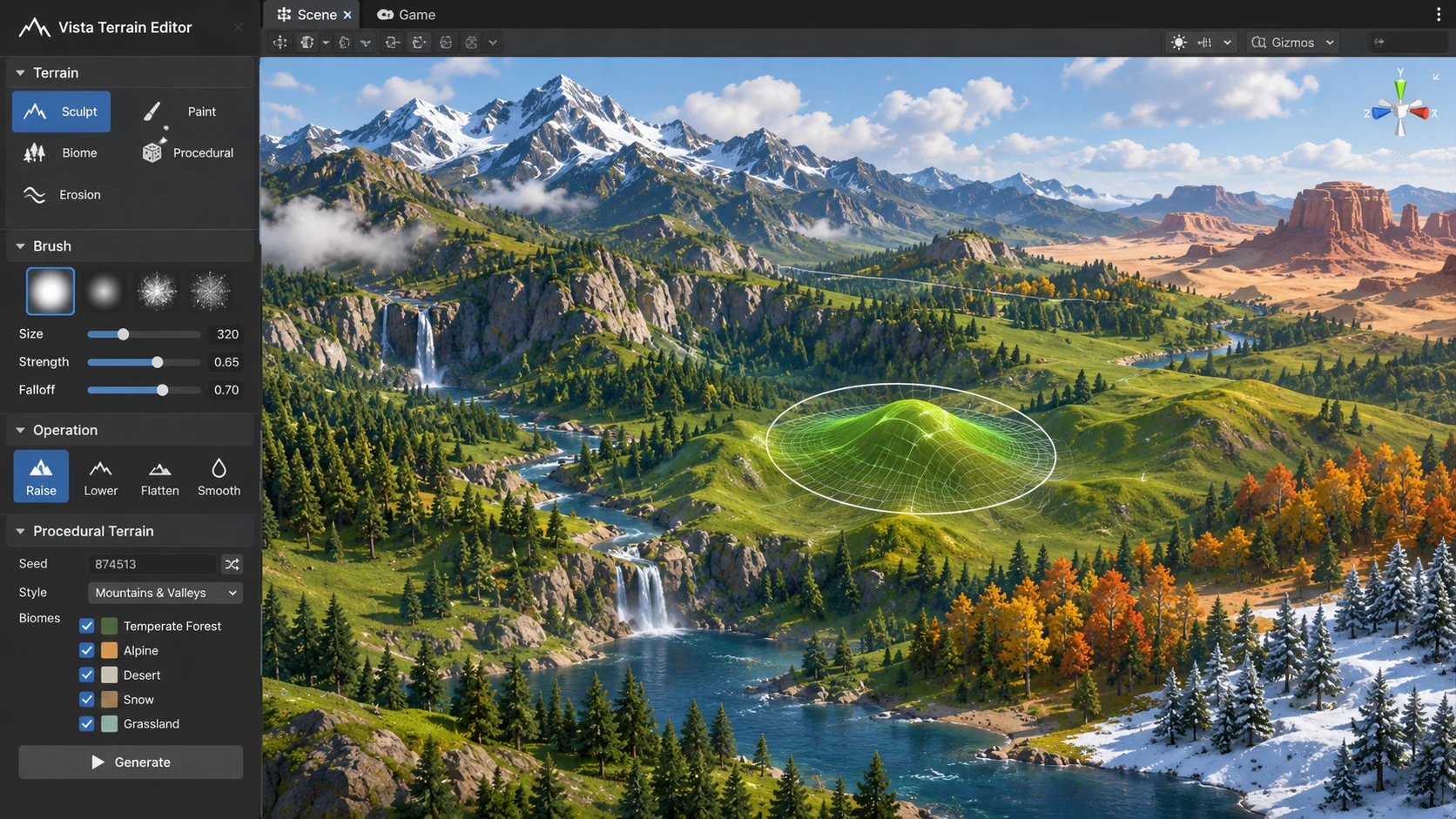
Vista Indie - Procedural Terrain Editor with Biomes has reached version 3000.4.0 on the Unity Asset Store, with November 5, 2026, shown as the latest release date. The package, published by Pinwheel Studio, is intended for procedural landscape creation and biome-based editing. Its product listing places it in the terrain-tool category and references graph-driven workflows for generating and texturing terrain.
A distinction matters for teams choosing such a tool: terrain created in the editor is not the same as terrain generated dynamically during gameplay. An editor workflow can produce saved height data, textures, and vegetation arrangements for a finished level. Runtime generation adds requirements involving target hardware, shader capabilities, loading, and potentially network synchronization. Treating both as one feature can lead to unrealistic platform plans.
The store shows compatibility with the Built-in Render Pipeline, URP, and HDRP for the Unity version in its compatibility table. That is helpful for a team moving between rendering setups, but it does not guarantee identical output under every pipeline. Material shading, fog, vegetation shadows, and post-processing may still need project-level checks. The publisher also describes compute-related limitations for specific terrain generation workflows.
For a small studio, procedural biomes can accelerate the construction of terrain variations: an area near a river might use different ground textures and vegetation from a hilltop, while a road corridor could override the default distribution. The main long-term advantage would be reproducibility, allowing a team to regenerate a terrain with adjusted rules rather than painting every change by hand. That remains a workflow hypothesis until tested with a particular package and map scale.
A useful evaluation would make a single square-kilometer sandbox and divide it into two biomes with a narrow transition. Generate the terrain, save it, close and reopen the project, and verify whether the result is stable. Then export or build the scene for its intended target and measure memory and loading time. If the project expects runtime generation, run that exact path on the actual supported hardware rather than inferring it from editor functionality.
The store confirms the dated version listing but does not independently document which individual changes arrived in 3000.4.0. Developers should review the publisher's documentation and backup existing terrain data before a production upgrade.
Rate this story
What did you think of this article?
Log in to rate this story, comment and like replies.
Log inNo comments yet. Be the first to share your thoughts.
More stories
Codex CLI 0.167.2 Changes Incremental Tool Updates on Vertex AI
OpenAI released Codex CLI 0.167.2 with incremental tool updates enabled by default for Google Cloud Vertex AI. The change is relevant to teams using that backend, but it is not a general Unreal or Unity agent feature.

ElevenLabs Previews Interaction Engine for More Natural Voice Agent Timing
At its New York summit, ElevenLabs previewed an Interaction Engine that manages turn-taking, interruptions and model selection in conversations. Real-time game NPC use remains a proposed application, not a shipped game integration.

ElevenLabs Releases a Unity SDK for Live Voice Conversations With NPCs
ElevenLabs has published a Unity SDK connecting scene characters to conversational voice agents. The developer documentation distinguishes supported desktop and WebGL targets from beta mobile and XR integration.
Comments