
Unity AI Inference LSTM Import Report Expands to Activation Ordering
A new October 31 follow-up to a Unity Inference Engine bug report describes a second potential ONNX LSTM import problem involving activation parameters. The issue is based on community analysis and is not yet listed as an official fix.
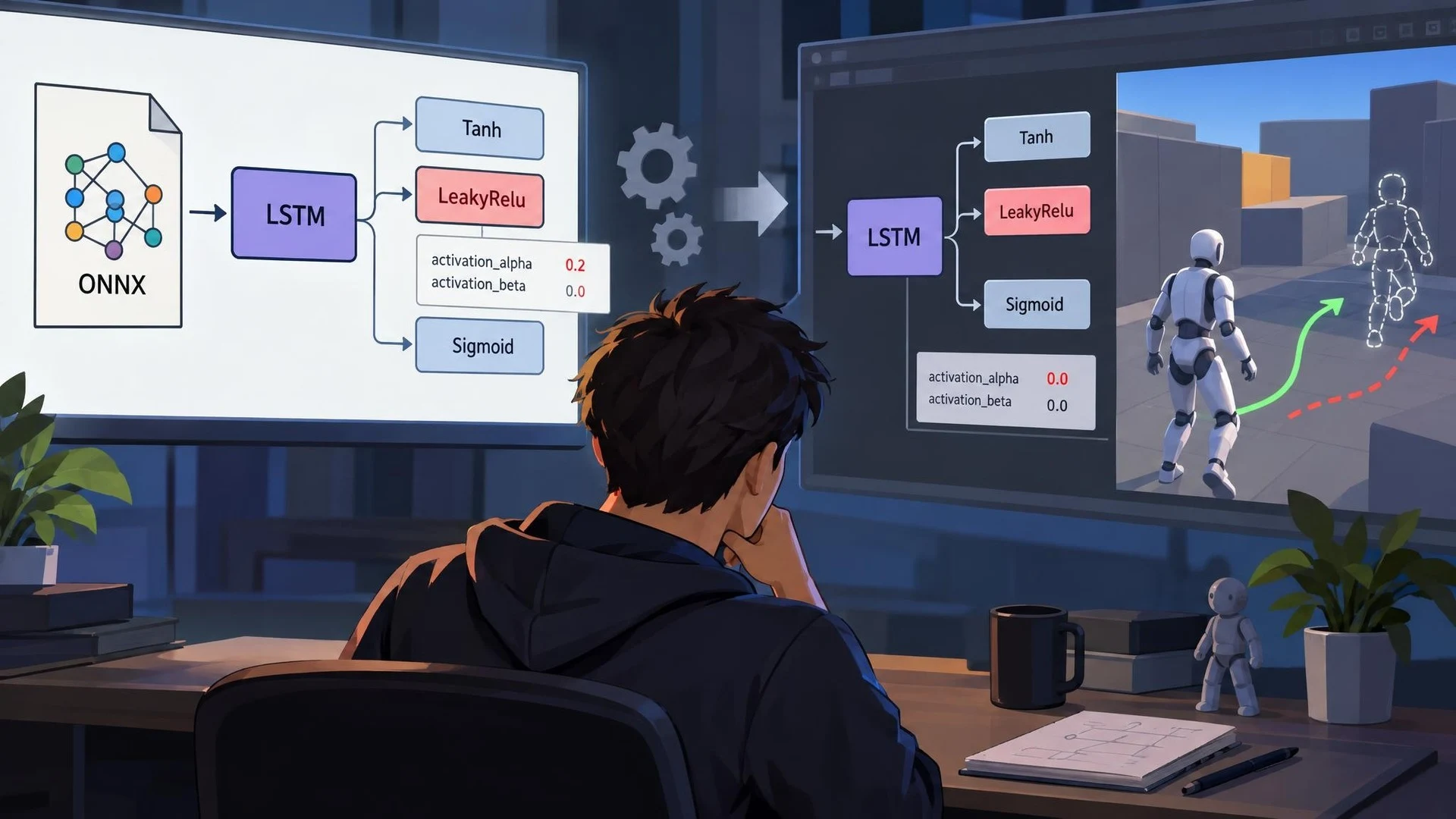
Importing a neural network is not always the same as preserving its behavior. Small differences in activation-function parameters can change predictions even when a model loads and runs without errors. A Unity community discussion about the AI Inference Engine received an important follow-up on October 31, 2026 concerning LSTM models imported from ONNX.
The original October 20 report identified a possible mismatch in the way Inference Engine package 2.6.1 looks up optional floating-point arrays. The developer says the import code searches for a single floating-point attribute type instead of the list-of-floats type used for values such as activation_alpha and activation_beta. As a result, certain LSTM configurations could silently receive defaults instead of the values stored in the model. A Unity representative acknowledged the initial report and said the team would investigate.
The October 31 update adds a related complication. According to the reporter, even after correcting the attribute lookup, the importer may assign activation parameters by position without skipping activation functions that do not use those parameters. The developer gives an example in which a custom LeakyRelu coefficient should apply to that activation but is instead consumed by an earlier function that ignores it.
These are concrete code observations from a user, not a confirmed Unity release note or official diagnosis. The scope is also narrow: it concerns particular ONNX LSTM activation configurations with non-default parameters, not every neural model imported into Unity. A typical feed-forward model or an LSTM using only standard defaults may not exhibit the same discrepancy.
The relevance to game development is increasing as teams consider local inference for NPC decision-making, procedural systems and player-behavior models. A model that produces subtly different outputs in Unity compared with its original training environment could lead to inconsistent decisions that look like gameplay bugs rather than import errors.
A careful verification would use a minimal ONNX model with an intentionally non-default LSTM activation coefficient, compute reference outputs in a known ONNX runtime, and compare them with outputs from Unity Inference Engine using identical inputs. Record the exact package version and avoid changing production inference code solely on the basis of an unmerged forum suggestion.
The October 31 update is significant because it argues that a single type-check correction might not fully solve the reported edge case. Developers should watch for official acknowledgement, issue tracking and package release notes before treating the fix as shipped.
Rate this story
What did you think of this article?
Log in to rate this story, comment and like replies.
Log inNo comments yet. Be the first to share your thoughts.
More stories

BlueprintReview Adds Timeline Navigation for Unreal Blueprint Changes
BlueprintReview gained a time-lapse view for Blueprint revision histories on November 1. The independent beta aims to make visual scripting changes easier to inspect without opening the Unreal Editor, including for teams using Git or Perforce.

Linux Vulkan Crash Report Links Runtime PCG Cleanup to GPU Resources
A detailed November 1 report describes a Vulkan crash during garbage collection in an Unreal Engine 5.8.3 Linux game using runtime-generated PCG and World Partition. The suspected uniform-buffer lifetime issue is not yet an officially verified root cause.

Free Unity Projectile Add-On Requires Two Paid Asset Packages
A new October 31 Unity Asset Store package links Mystic Arsenal spell effects with Projectile Factory. The add-on itself is free, but the store explicitly lists two paid dependencies required for it to function.
Comments