
Unity 6000.6.8f1 Fixes Physics Broadphase and Linux Editor Problems
Unity 6000.6.8f1 includes targeted physics fixes, including incremental broadphase checks, alongside Linux headless editor repairs and security updates. These are distinct fixes in the 6000.6 branch.
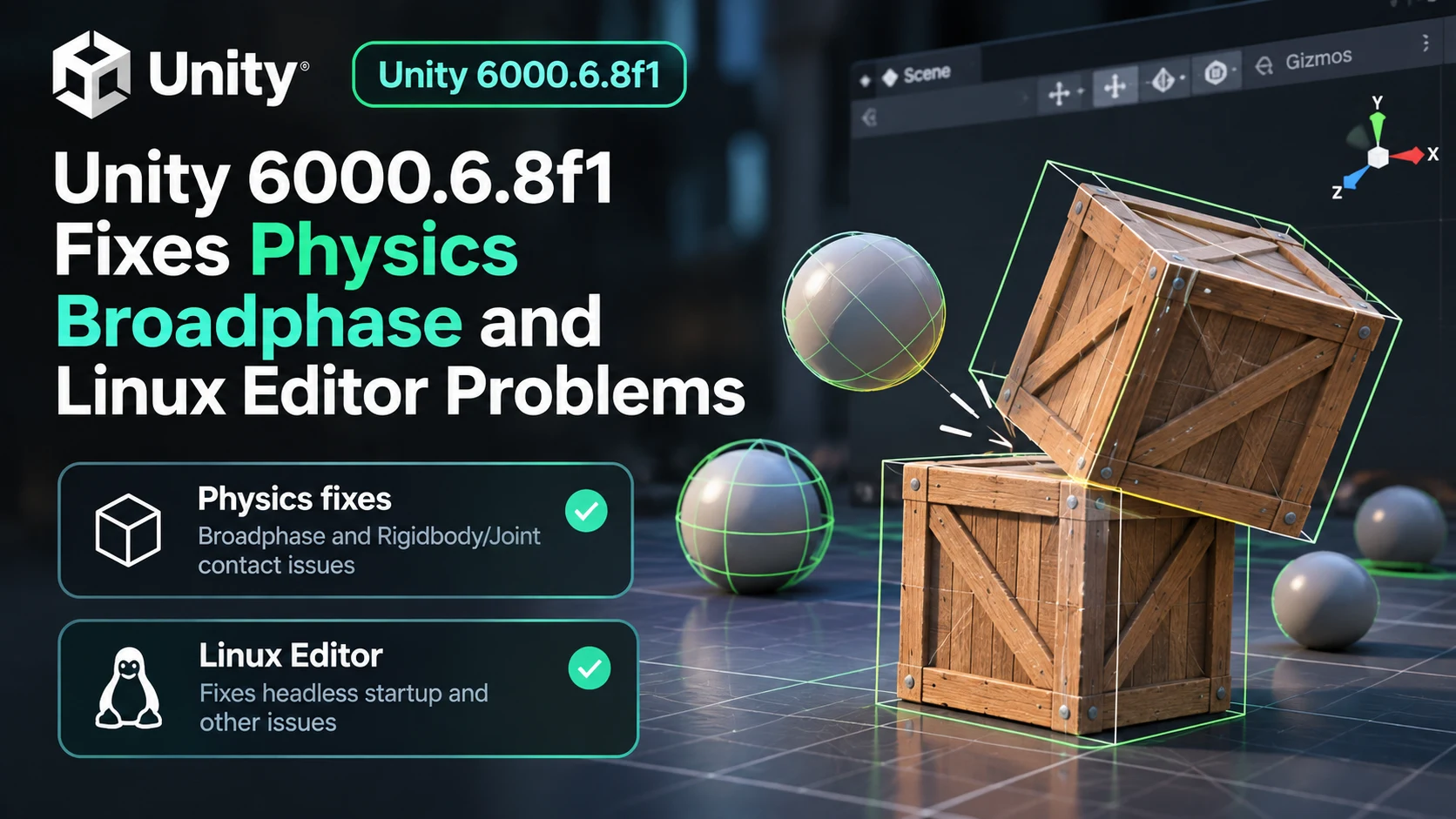
Unity released Editor version 6000.6.8f1 on November 3 with an extensive list of fixes across graphics, scripting, physics, networking and development environments. This patch belongs to the 6000.6 release line, and its contents should not be conflated with a separate 6000.0 maintenance patch published around the same period. For teams already working in this branch, several physics corrections deserve closer attention.
One change addresses failures associated with incremental broadphase operation, including repeated integrity-check errors in particular simulation sequences and collision problems after broadphase options were toggled. Broadphase systems are responsible for efficiently identifying candidate pairs of objects that may collide. Faults at this stage can produce missing contacts or warnings even when individual colliders appear to be configured correctly.
Another fix concerns newly connected Rigidbody objects and Joint components. Unity states that joints now prompt the appropriate reevaluation of contacts so collision-related flags can take effect as intended. The release notes also include several Physics 2D corrections involving ray casts, masks, invalid handles and diagnostic messages. These are specific resolved cases, not evidence that every physics inconsistency in a project is fixed by the update.
Developers running automated builds on Linux have a separate reason to review this version. Unity corrected a crash when the editor started without an initialized video subsystem, such as in certain headless or no-graphics configurations. It also improved the response to invalid combinations of command-line flags. These changes matter to continuous integration and unattended testing, although teams should still validate their exact launch arguments, licenses and package versions.
The patch also addresses a Brotli decompression security vulnerability and an issue involving compromised TLS certificates. Teams processing untrusted compressed data should review the security notes instead of focusing only on visible gameplay issues. As with any engine maintenance update, applying it should follow a controlled regression test rather than an assumption that every project benefits without risk.
A focused verification plan would make a physics scene that creates rigid bodies after startup, toggles the relevant broadphase setting if used by the project, and records collisions and warnings before and after updating. A second test could launch a clean editor build in the project's Linux automation environment. That would establish whether the documented fixes matter to the team's actual workflows, while keeping the results separate from Unity's published release notes.
Rate this story
What did you think of this article?
Log in to rate this story, comment and like replies.
Log inNo comments yet. Be the first to share your thoughts.
More stories
Codex CLI 0.167.2 Changes Incremental Tool Updates on Vertex AI
OpenAI released Codex CLI 0.167.2 with incremental tool updates enabled by default for Google Cloud Vertex AI. The change is relevant to teams using that backend, but it is not a general Unreal or Unity agent feature.
ElevenLabs Previews Interaction Engine for More Natural Voice Agent Timing
At its New York summit, ElevenLabs previewed an Interaction Engine that manages turn-taking, interruptions and model selection in conversations. Real-time game NPC use remains a proposed application, not a shipped game integration.

Unity MCP 1.10.0 Adds Screenshot Saving for Game Editor Agents
A community-maintained Unity MCP bridge has released version 1.10.0, adding an option for screenshot tools to save PNGs inside a project. The feature can support reviewable visual feedback when AI agents work on scenes.
Comments