
The 2026 Epic AI MegaJam Begins With Unreal and UEFN Tracks
Epic’s four-day AI MegaJam begins November 12 after a November 11 kickoff. Small teams can build playable projects in Unreal Engine or UEFN, with distinct submission tracks and optional AI assistance.
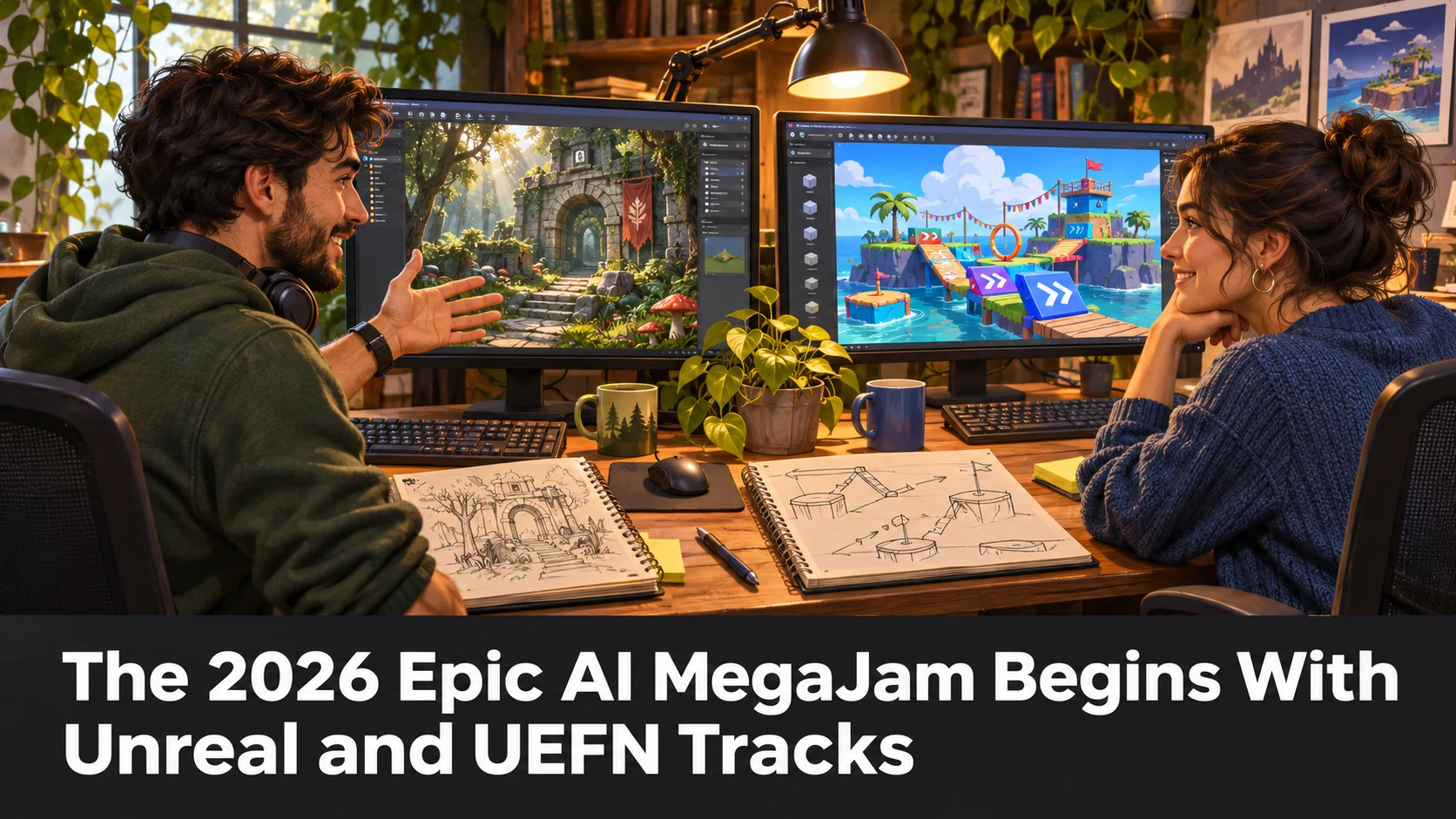
The 2026 Epic AI MegaJam reaches its scheduled development window on November 12, following the official kickoff livestream on November 11. Epic first announced the event on October 22, so the start date is a new milestone in an existing event rather than a freshly announced competition.
The schedule runs through November 15, and Epic describes a format in which up to five human teammates can work alongside any number of AI agents. Participants may build with Unreal Engine or Unreal Editor for Fortnite, commonly called UEFN. Although those tools share some technology, they are different creation and publishing environments. Entrants choose one track and follow its relevant rules; a UEFN project should not be described as an ordinary packaged Unreal desktop game.
Epic's announcement includes categories for overall Unreal Engine and UEFN entries, student projects and special modifiers. Awards include cash prizes, with the highest listed main-category places receiving $7,500. Separate development continuation grants of up to $50,000 may be available to selected projects, but such grants are competitive possibilities rather than guaranteed payments to participants.
The AI angle is deliberate, but Epic's forum guidance says AI use is not mandatory. A sensible workflow for a four-day event is still to define a narrow gameplay loop, establish a working build early and use automation where it saves verified work. Coding agents can draft C++ or Blueprint support scripts, but gameplay correctness, packaging, art provenance and stability remain the team's responsibility.
For example, a small team could prototype a one-room action game with a single enemy type and one progression mechanic. The first session could establish input and a playable encounter, the second could add a consistent art direction, and later sessions could be devoted to bug fixing and packaging. The point is to avoid mistaking a successful prompt for a playable release.
Game creators should review the official competition rules, the event's development start restrictions and submission deadlines. Work prepared before the jam may need to be declared, as explained in Epic's community FAQ. Participants should also preserve a stable submission build independently of any version they continue developing afterward.
For observers who are not entering, the event is an opportunity to compare how teams document AI-assisted development and how quickly prototypes become testable games. It is not evidence that agent-generated games automatically meet commercial production requirements.
Rate this story
What did you think of this article?
Log in to rate this story, comment and like replies.
Log inNo comments yet. Be the first to share your thoughts.
More stories
Codex CLI 0.167.2 Changes Incremental Tool Updates on Vertex AI
OpenAI released Codex CLI 0.167.2 with incremental tool updates enabled by default for Google Cloud Vertex AI. The change is relevant to teams using that backend, but it is not a general Unreal or Unity agent feature.
ElevenLabs Previews Interaction Engine for More Natural Voice Agent Timing
At its New York summit, ElevenLabs previewed an Interaction Engine that manages turn-taking, interruptions and model selection in conversations. Real-time game NPC use remains a proposed application, not a shipped game integration.
Unity MCP 1.10.0 Adds Screenshot Saving for Game Editor Agents
A community-maintained Unity MCP bridge has released version 1.10.0, adding an option for screenshot tools to save PNGs inside a project. The feature can support reviewable visual feedback when AI agents work on scenes.
Comments