
Survivor Roguelite Maker Adds a Data-Driven Unity Game Template
FlyCat has released a Unity template centered on wave survival, upgrades and balance analysis. The package provides a C# framework and editor tools, while its developer separately discloses AI assistance in code and audio production.
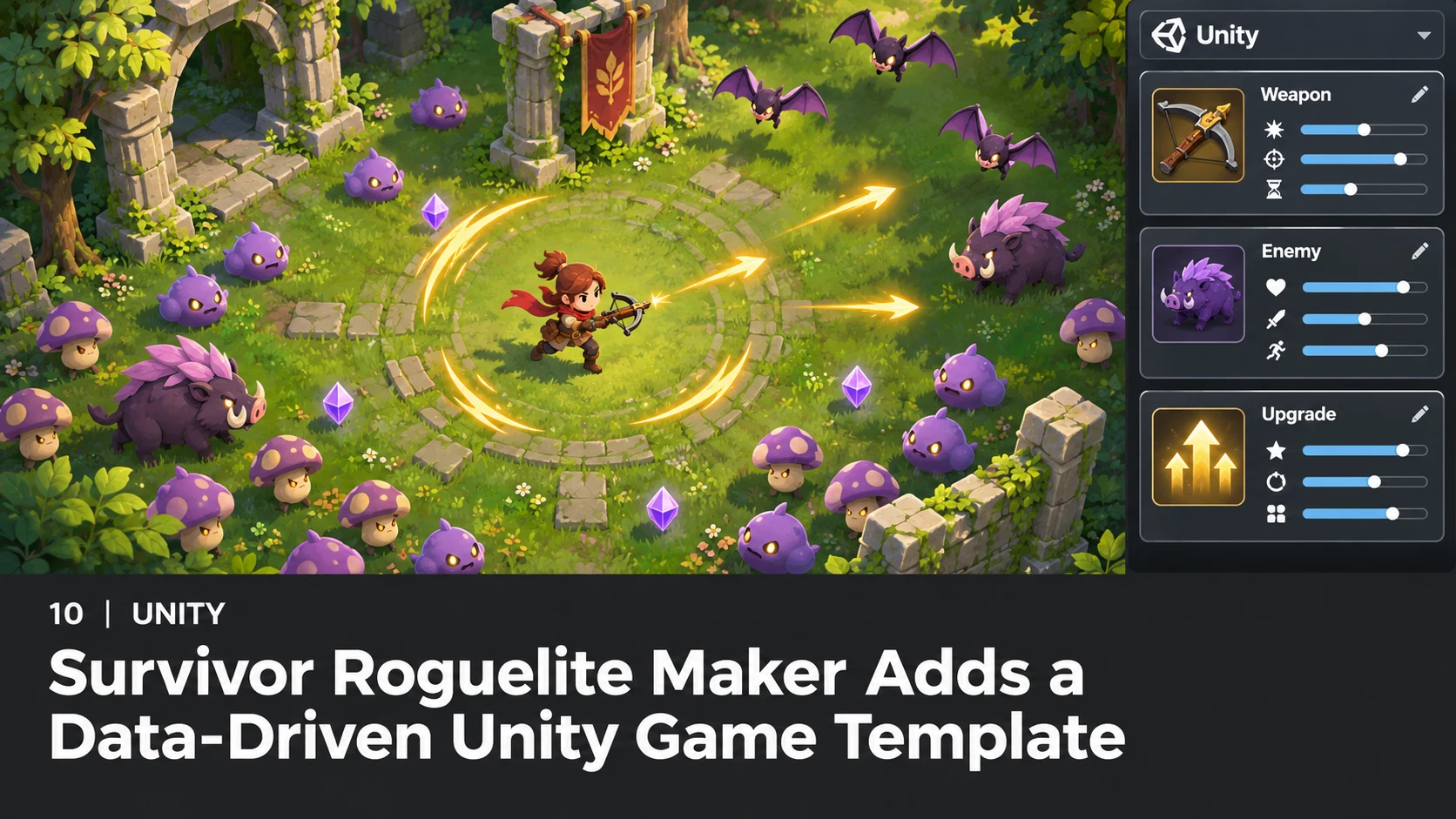
Unity developers exploring arena-survival games have another template to evaluate. Survivor Roguelite Maker, released on the Asset Store on November 10 by FlyCat, is described as a C# framework for building 2D survivor roguelites. It covers authoring data, combat loops, enemy waves, item progression and test utilities, rather than offering a finished commercial game.
The publisher outlines two progression structures. In an arena flow, players can reach a shop between waves; in a field flow, level-up choices can appear during combat. Combat options include ranged and melee attacks, auras, orbiting weapons and homing projectiles. Encounter data can describe elites, multi-phase bosses, horde events and status effects. The system is intended to accept custom presentation and assets through several layers of authoring tools.
A notable part of the product is its emphasis on balancing before release. The listed editor tools include a Wave Editor, Balance Simulator, Run Pacing view, Build Lab, Weapon Lab and Horde Preview. The publisher says developers can compare builds and replay or inspect recorded wave conditions. These are meaningful workflow ideas, although the supplied store text does not independently establish the statistical accuracy of the simulations or the quality of combat balancing.
The technical notes mention Unity 6000.0-based support, compatibility with Built-in and URP for its 2D sample, and dependencies on Unity UI and Input System packages. The listing also contains an unusually explicit AI disclosure: the publisher says coding assistants contributed to its code, tools and documentation, and Stable Audio 3 generated music and sound effects locally. These statements refer to how the package was made; they are not claims that the runtime contains a generative AI system.
An evaluation should use a fresh sample project, run a default wave and then alter one parameter at a time: enemy count, damage, upgrade frequency and shop prices. Compare the editor's predicted pacing with actual playtests, documenting where expectations diverge. Inspect extension points before replacing the demo visuals or importing the system into an existing codebase.
Templates can shorten prototyping, but maintainability depends on the underlying structure and clarity of the source. For small teams, the stronger question is whether this framework supports the kind of game they want to evolve, not how quickly its demonstration can be launched.
Rate this story
What did you think of this article?
Log in to rate this story, comment and like replies.
Log inNo comments yet. Be the first to share your thoughts.
More stories
Codex CLI 0.167.2 Changes Incremental Tool Updates on Vertex AI
OpenAI released Codex CLI 0.167.2 with incremental tool updates enabled by default for Google Cloud Vertex AI. The change is relevant to teams using that backend, but it is not a general Unreal or Unity agent feature.
ElevenLabs Previews Interaction Engine for More Natural Voice Agent Timing
At its New York summit, ElevenLabs previewed an Interaction Engine that manages turn-taking, interruptions and model selection in conversations. Real-time game NPC use remains a proposed application, not a shipped game integration.
ElevenLabs Releases a Unity SDK for Live Voice Conversations With NPCs
ElevenLabs has published a Unity SDK connecting scene characters to conversational voice agents. The developer documentation distinguishes supported desktop and WebGL targets from beta mobile and XR integration.
Comments