
Sound Manager Visual Sound Designer Debuts for Unity URP Projects
The new third-party Unity sound-design extension introduces graph-oriented audio workflows. Its Asset Store listing specifies Unity 6000.6, URP compatibility and important pipeline exclusions.
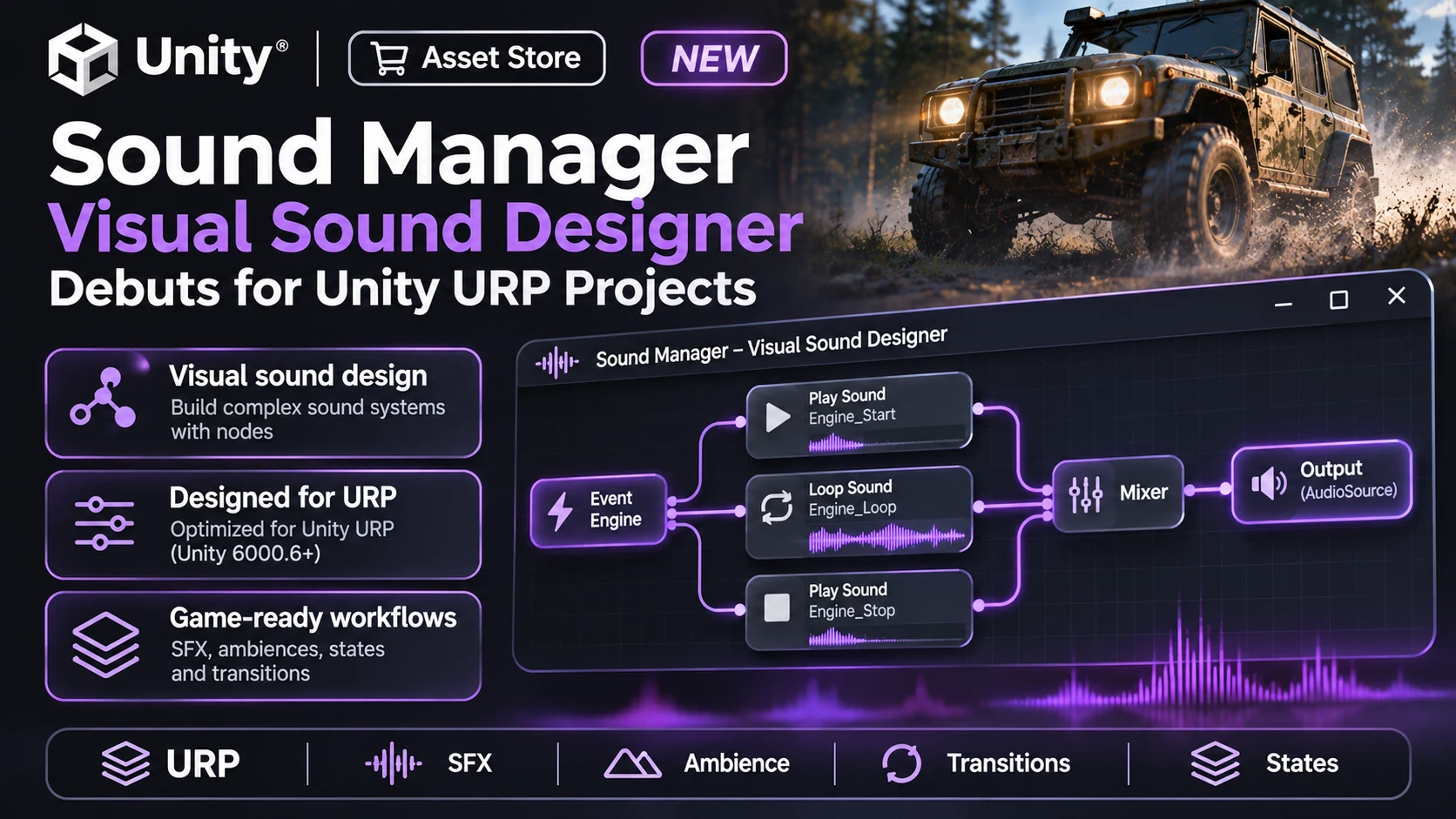
A new Unity Asset Store extension titled Sound Manager – Visual Sound Designer received its version 1.0.0 release on November 3. The publisher positions it as a visual tool for organizing game sound behavior, rather than requiring every variation and transition to be hand-coded in C#. Its listing identifies Unity 6000.6.0 as the original editor version and notes compatibility with the Universal Render Pipeline.
Audio often becomes complex long before a game's art pipeline is finished. A single machine can produce an idle hum, a startup sequence, impacts, alerts and shutdown noises. Footsteps need variants; ambient sound should change with location or weather; UI sounds should react consistently to repeated actions. A graph-oriented sound manager offers a way to express some of those relationships visually and keep designers from scattering audio rules across unrelated gameplay scripts.
The store's compatibility matrix deserves attention. It marks the package as compatible with URP under the listed Unity version, while identifying Built-in Render Pipeline and HDRP as incompatible. Those labels should not be ignored just because the primary task involves audio; a tool may have editor presentation, examples or dependencies tied to a particular render pipeline. Developers should check the actual implementation and any required packages before assuming it can be moved into a different Unity project unchanged.
This is a paid third-party extension rather than a new Unity Editor capability. The product page also includes an AI content disclosure, which should be considered when evaluating included demonstration material and the rights attached to it. A store listing can document declared requirements, but it cannot independently prove performance, ease of integration or long-term maintenance quality.
A sensible trial would implement one vehicle or generator sound set in a blank URP project: idle loop, acceleration, impact and warning. Designers could measure whether the graph is easier to edit than existing mixer and script logic. They should test rapid state changes, overlapping clips, pooled sources, volume behavior and performance under repeated triggers. Finally, they should compare the tool with Unity's native audio features, because an additional dependency is only useful if it reduces complexity in the project's real workflow. The promising news is a new option for visual sound authoring, not a reason to replace a stable audio system without evidence.
Rate this story
What did you think of this article?
Log in to rate this story, comment and like replies.
Log inNo comments yet. Be the first to share your thoughts.
More stories
Codex CLI 0.167.2 Changes Incremental Tool Updates on Vertex AI
OpenAI released Codex CLI 0.167.2 with incremental tool updates enabled by default for Google Cloud Vertex AI. The change is relevant to teams using that backend, but it is not a general Unreal or Unity agent feature.
ElevenLabs Previews Interaction Engine for More Natural Voice Agent Timing
At its New York summit, ElevenLabs previewed an Interaction Engine that manages turn-taking, interruptions and model selection in conversations. Real-time game NPC use remains a proposed application, not a shipped game integration.
ElevenLabs Releases a Unity SDK for Live Voice Conversations With NPCs
ElevenLabs has published a Unity SDK connecting scene characters to conversational voice agents. The developer documentation distinguishes supported desktop and WebGL targets from beta mobile and XR integration.
Comments