
OpenAI Details Pando, a Git Backend Built for Parallel Coding Agents
OpenAI has described Pando, its Git-compatible source-control backend designed to handle many simultaneous pushes and fast fetches. The November 2 engineering article offers lessons for agent-heavy repositories, although Pando is not announced as a public download.
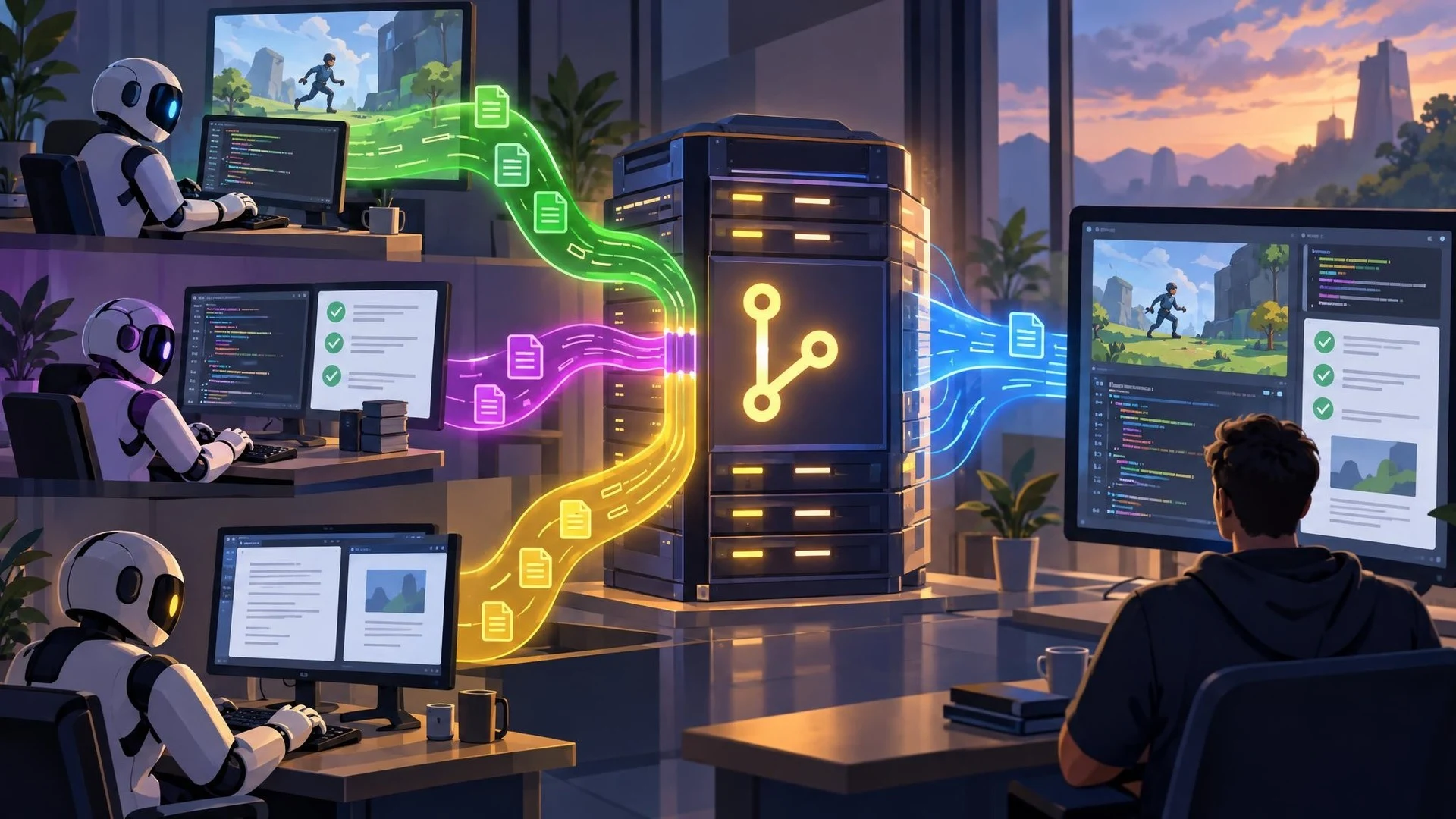
A growing number of coding agents can work on separate changes at the same time, but all of their work eventually passes through source control. On November 2, 2026, OpenAI published an engineering article explaining Pando, a Git-compatible backend it built to handle the demands of many concurrent engineering and agent workflows.
The company says the system now supports its internal monorepo and was designed around two priorities: scaling writes across many branches and maximizing read throughput for clients fetching repositories. OpenAI reports an almost fivefold reduction in median push latency in its production environment and nearly a petabyte of Git data delivered daily. These figures describe OpenAI's own infrastructure, not a publicly benchmarked product offered to game studios.
The central technical problem is coordination. In many repository architectures, concurrent pushes eventually compete to update some shared metadata. Adding more machines to store or serve data does not remove every coordination bottleneck. Pando changes parts of the backend architecture while preserving compatibility with Git clients and protocol expectations.
That has a practical connection to AI game development. A team might assign one agent to gameplay code, another to unit tests and a third to documentation. Even if all three agents produce good patches, their work can collide when branches are integrated. Source control must make changes visible, isolate work and help developers resolve conflicts.
For smaller teams, Pando's design lessons are more useful than the idea of deploying an equivalent backend. Most indie projects do not need infrastructure capable of OpenAI's reported traffic. They do need sensible branch naming, automated checks, clear file ownership and a process for merging changes in a controlled order.
A lightweight experiment could use a Unity or Unreal repository with two isolated worktrees. Give each coding agent a different, non-overlapping source task. Have both run appropriate local checks before creating commits. Then merge sequentially into an integration branch and rerun the complete test suite. Record how often agents modify shared configuration or generate files that are difficult to review.
Large binary game assets introduce additional challenges. Git LFS or another asset-management system may be needed when a repository contains large textures, meshes and packaged content. Pando's publication does not establish a new universal solution for every game asset pipeline, and engine-specific binary merge problems remain separate from server-side Git throughput.
OpenAI's engineering article is a case study in scaling internal infrastructure for agent-assisted software work. It does not announce general public access to Pando or direct integration with Unity and Unreal Editor. Its immediate takeaway is that parallel AI programming requires dependable version-control practices as much as capable models.
Rate this story
What did you think of this article?
Log in to rate this story, comment and like replies.
Log inNo comments yet. Be the first to share your thoughts.
More stories
Fortnite Ecosystem 43.00 Brings PCG and New MCP Tools to UEFN
Epic has released Fortnite Ecosystem 43.00 with editor-time PCG, new UEFN MCP capabilities and a production-ready quest Progression API. The changes apply to the Fortnite creator environment, not automatically to conventional Unreal Engine projects.
OpenAI Announces Pierre Acquisition to Expand Codex Git Workflows
OpenAI plans to acquire Pierre Computer Company, whose open-source file-tree and code-diff libraries already appear in Codex. The announcement focuses on future developer workflows and is not yet a newly shipped game-engine integration.

Epic Marks Unreal Engine 5.8 Garbage Collection Regression Fixed for 5.8.5
An Epic forum bug-report update says a reported Unreal Engine 5.8 garbage collection slowdown is resolved internally and scheduled for the 5.8.5 hotfix. Developers should not confuse the future fix designation with a patch already installed.
Comments