
Epic Updates Pixel Streaming Signalling With Security and Session Fixes
Epic published fresh signalling-library packages for Unreal Pixel Streaming, addressing server crashes, message limits and session switching. The changes are particularly relevant to teams operating browser-streamed games for multiple players.
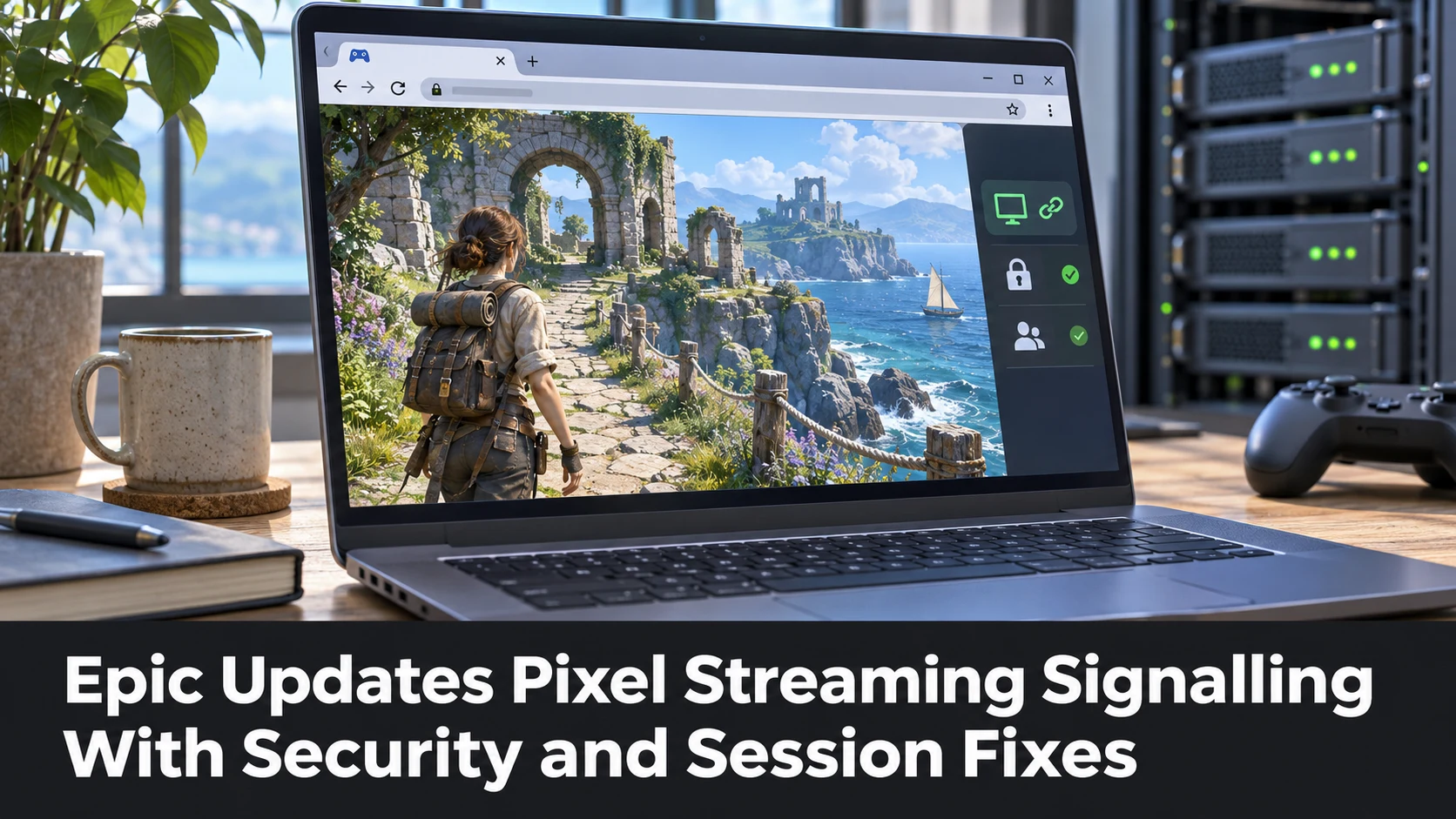
Epic Games published updated Pixel Streaming Infrastructure signalling packages on November 10, 2026. The official GitHub releases include a signalling package for Unreal Engine 5.8, with corresponding updates for other maintained branches. These are infrastructure-library changes, not a new Unreal Engine renderer or a cloud gaming service.
Several entries deal with the behaviour of a shared signalling server when players, streamers and selective forwarding units interact. According to the release notes, an SFU changing subscriptions previously could keep forwarding data from its old streamer. A later disconnect from that old streamer could then remove players from the stream to which the SFU had actually moved. The new change unsubscribes first, mirroring the approach already used for ordinary player connections.
Other fixes strengthen the server against malformed or excessive client traffic. The published notes describe rejection of malformed messages that could previously trigger an exception in a WebSocket event handler, including a null JSON message. They also specify a one-megabyte WebSocket payload limit for streamer, player and SFU ports, with configuration hooks for operators that need different limits. Logging is bounded too: very long messages are truncated and rotating log files have size and count limits.
For operators running multiple customers on shared infrastructure, these details matter more than they might appear from a version number. A crash in the signalling process can interrupt otherwise healthy GPU game sessions. An incorrectly retained subscription can affect a player who has already switched streams. Unbounded log growth can consume storage even if the rendering workload itself is stable.
The release page also describes improvements to per-connection TURN credentials and authorization interfaces in the same release history. Developers should inspect the actual package and change range they deploy rather than assume every listed change first appeared in the newest patch. Some controls require deliberate server configuration and do not become effective merely by upgrading a package.
A useful regression test would connect two test players and two streamers to a staging signalling server, repeatedly switch an SFU between streams and abruptly disconnect the previously selected streamer. The team could then verify subscription state, reconnection behaviour and logs. A separate test should send invalid signalling messages through an authorized test client and confirm that the server remains running. These are proposed checks, not results of an independent test.
Pixel Streaming carries the rendered game as video to the browser; it is fundamentally different from compiling an Unreal project to run locally with WebAssembly and WebGPU. Developers should evaluate both architectures separately when choosing how players will access their games.
Rate this story
What did you think of this article?
Log in to rate this story, comment and like replies.
Log inNo comments yet. Be the first to share your thoughts.
More stories
Codex CLI 0.167.2 Changes Incremental Tool Updates on Vertex AI
OpenAI released Codex CLI 0.167.2 with incremental tool updates enabled by default for Google Cloud Vertex AI. The change is relevant to teams using that backend, but it is not a general Unreal or Unity agent feature.
ElevenLabs Previews Interaction Engine for More Natural Voice Agent Timing
At its New York summit, ElevenLabs previewed an Interaction Engine that manages turn-taking, interruptions and model selection in conversations. Real-time game NPC use remains a proposed application, not a shipped game integration.

Unity MCP 1.10.0 Adds Screenshot Saving for Game Editor Agents
A community-maintained Unity MCP bridge has released version 1.10.0, adding an option for screenshot tools to save PNGs inside a project. The feature can support reviewable visual feedback when AI agents work on scenes.
Comments