
Epic Previews Unreal MCP and Mesh Terrain Demos for I/ITSEC 2026
Epic has outlined its November 30–December 3 simulation showcase, including experimental Mesh Terrain, Unreal MCP, PCG examples and Cesium geospatial demonstrations. The announcement concerns upcoming demonstrations, not a new engine release.
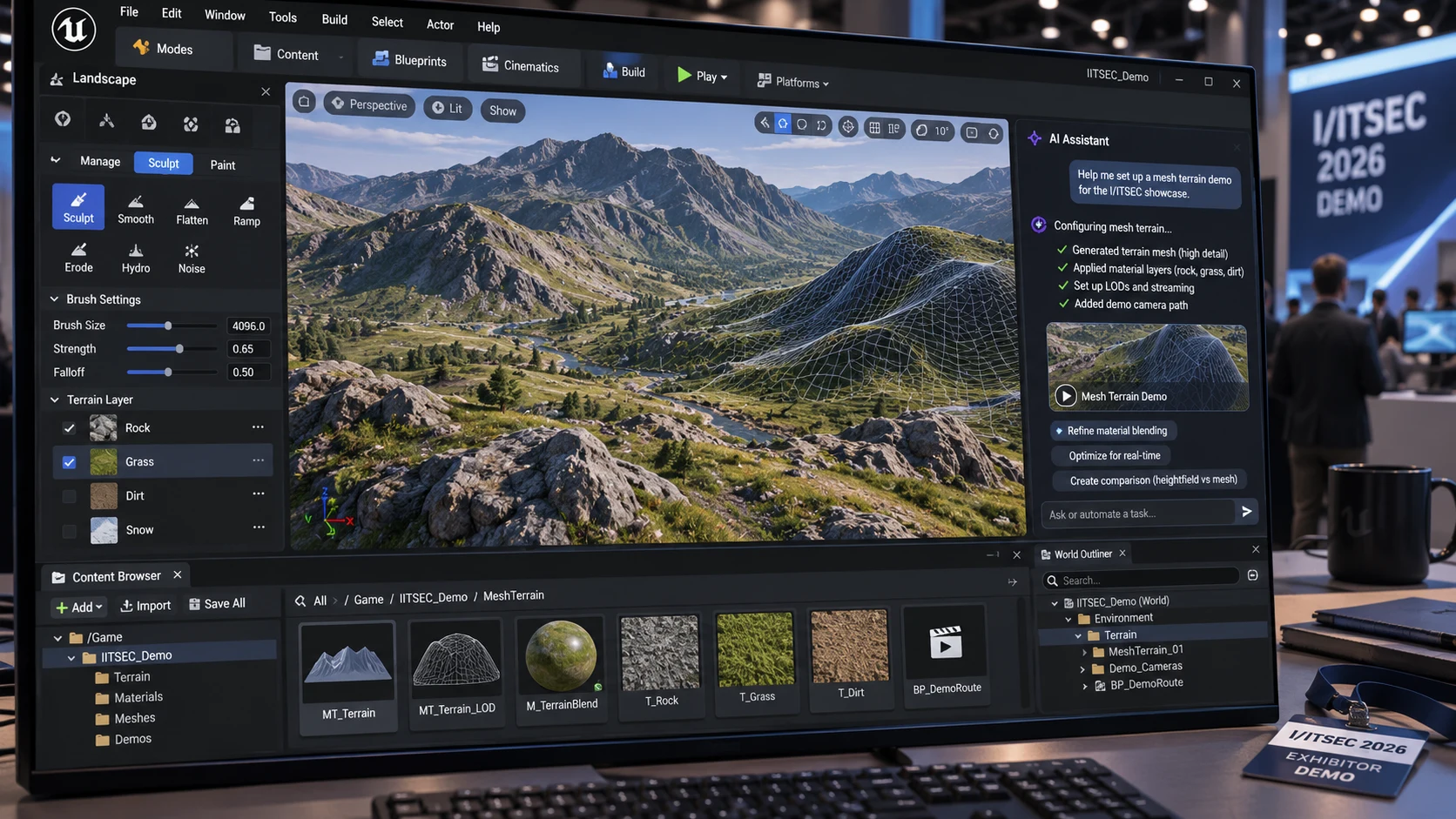
Epic Games published its plans for I/ITSEC 2026 on November 4, setting out demonstrations that connect Unreal Engine's world-building tools with geospatial data and AI-assisted editor workflows. The conference is scheduled for November 30 through December 3, so the announcement should be read as a preview of what Epic and Cesium intend to show, not evidence that the announced demonstrations have already taken place.
One highlighted subject is Mesh Terrain in Unreal Engine 5.8. Epic describes the system as Experimental and positions it as a way to construct terrain shapes that traditional heightmaps cannot easily represent, including tunnels, cliffs, and overhangs. Those possibilities matter for large open environments, but Experimental status is a warning against assuming that every workflow is stable for a shipping game. Teams should review feature limitations, serialization behavior, and performance on their own hardware.
Epic is also featuring Unreal MCP, its first-party Model Context Protocol server for the Unreal Editor. The company identifies this as an Experimental plugin shipped with Unreal Engine 5.8. It provides a connection for compatible coding agents and tools such as Claude Code or Cursor to operate capabilities exposed by the editor. It is not the same as an AI model automatically creating a finished game, and the number of actions an agent can perform depends on available tools and permissions.
Cesium's participation adds a separate geospatial angle. Its planned demonstrations include vector tiles, stylized real-world visualization, Gaussian splatting with levels of detail, and workflow updates around Cesium ion. Epic also plans examples involving Procedural Content Generation, together with AI-assisted applications such as a geospatial explorer and a LiDAR sensor simulator. These are distinct technologies, and a demo of one does not imply all features are part of a single built-in Unreal subsystem.
A useful preparation exercise would be a small copied project with one procedural landscape area and a narrowly scoped Unreal MCP command. Keep the test under version control, ask an agent to inspect or place an object, and confirm the resulting asset in the editor before accepting it. For geospatial experiments, measure memory and streaming behavior separately. The event may provide valuable design patterns, but its announced demonstrations are not substitutes for compatibility and deployment testing.
Rate this story
What did you think of this article?
Log in to rate this story, comment and like replies.
Log inNo comments yet. Be the first to share your thoughts.
More stories
Claude Code Adds Background MCP Tasks and Tighter Agent Permission Controls
Anthropic’s Claude Code 2.1.319 introduced asynchronous MCP tasks and new permission controls. These features may help game developers manage long-running Unreal or Unity tool operations without blocking every agent step.
Codex CLI 0.167.2 Changes Incremental Tool Updates on Vertex AI
OpenAI released Codex CLI 0.167.2 with incremental tool updates enabled by default for Google Cloud Vertex AI. The change is relevant to teams using that backend, but it is not a general Unreal or Unity agent feature.

ElevenLabs Previews Interaction Engine for More Natural Voice Agent Timing
At its New York summit, ElevenLabs previewed an Interaction Engine that manages turn-taking, interruptions and model selection in conversations. Real-time game NPC use remains a proposed application, not a shipped game integration.
Comments