
Epic Details MegaJam Partner Offers From Meshy, Tripo and Animation Tool Makers
Epic has published a detailed list of partner credits and tools for the 2026 AI MegaJam. Offers cover 3D generation, character animation, coding agents and source control, but eligibility and expiry rules differ.
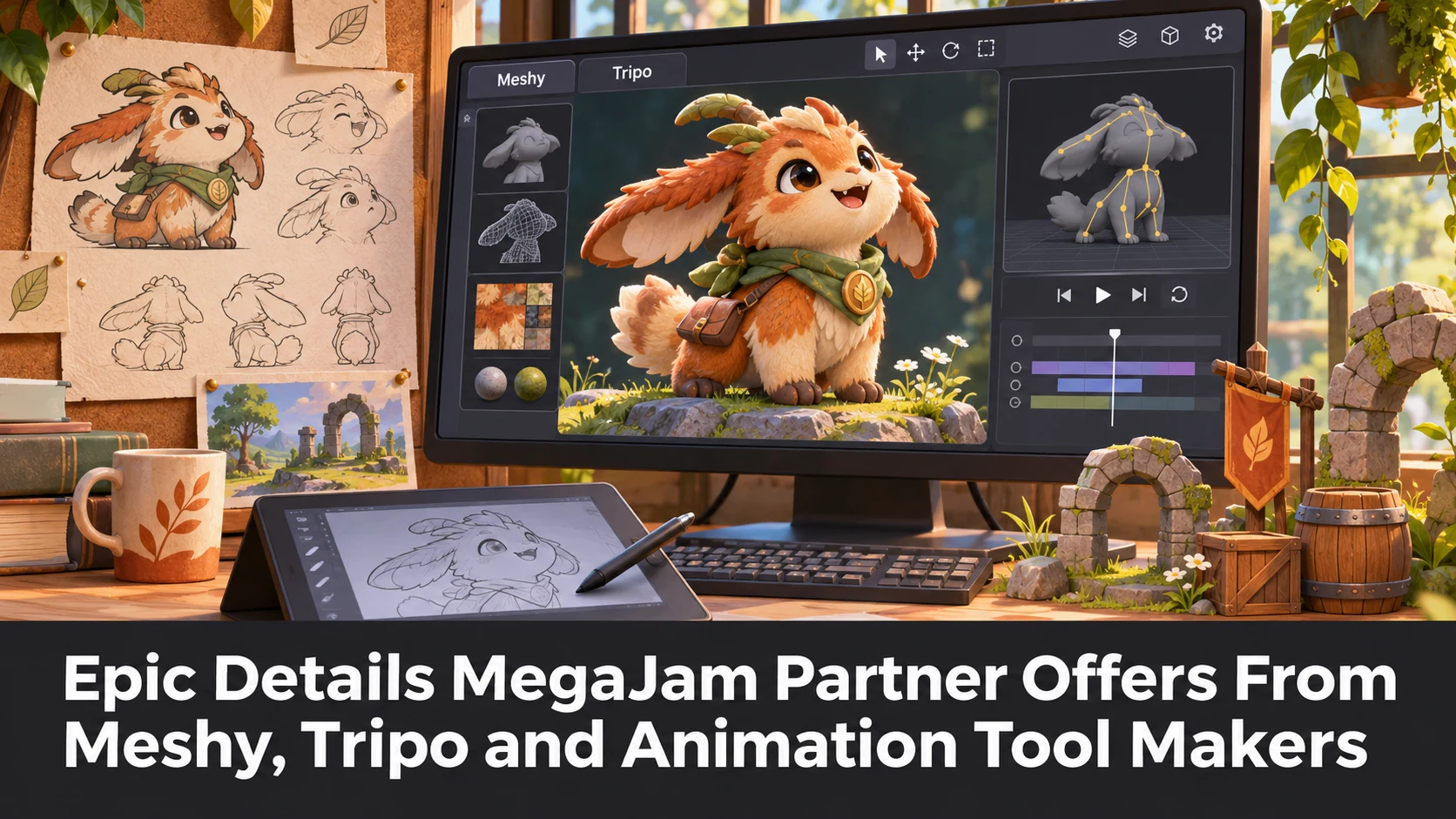
Epic Games published the detailed partner programme for its 2026 Epic AI MegaJam on November 10. The list brings together companies offering credits, temporary access and prizes to registered participants of the November 12–15 event. Unlike a major engine feature announcement, this is a time-limited opportunity for creators who want to compare practical production tools during a game jam.
For 3D workflows, Epic lists one month of Meshy Pro with 1,000 credits, subject to creating a new account through a campaign link by November 17. The offer requires a credit card and is described as renewing automatically after the month unless cancelled. Tripo's listed benefit is 3,000 credits and seven days of Pro access during the November 11–17 window in Pacific time, with a redemption deadline of November 16. These are event offers, not statements that either company's underlying models were updated on November 10.
Character work is represented as well. Reallusion offers eligible first-time users access to iClone PERSONAL with up to 30 exports; Rokoko lists a month of its Basic plan. Epic also names AI-enabled pipelines for preparing and animating characters, but the listing does not independently establish that assets generated with those tools will work without cleanup in every Unreal project.
Other benefits relate to the production process. Anthropic lists a small allocation of Claude API credits, while SpaceXSI describes credits for Cursor and Grok Bot. Diversion supplies a temporary source-control offer. The details are worth reading because a credit intended for a web application is not necessarily interchangeable with a pay-as-you-go API balance, and several vouchers have short claim or usage windows.
One possible experiment is to model the same modest prop using two different 3D generation tools, then export both to Unreal. Developers could compare topology, UV layout, texture consistency, collision setup, LOD suitability and actual time spent fixing the import. For character animation, a second test could check whether rigs and animation clips survive export and retargeting. No such comparison is claimed here.
The event accepts projects developed in Unreal Engine or Unreal Editor for Fortnite. Those are separate environments with separate submission processes and capabilities. Teams should choose their track and inspect the rules before building. The advertised perks are optional; they do not imply that participants must use generative AI or that a particular tool is endorsed for production use.
Rate this story
What did you think of this article?
Log in to rate this story, comment and like replies.
Log inNo comments yet. Be the first to share your thoughts.
More stories
Codex CLI 0.167.2 Changes Incremental Tool Updates on Vertex AI
OpenAI released Codex CLI 0.167.2 with incremental tool updates enabled by default for Google Cloud Vertex AI. The change is relevant to teams using that backend, but it is not a general Unreal or Unity agent feature.
ElevenLabs Previews Interaction Engine for More Natural Voice Agent Timing
At its New York summit, ElevenLabs previewed an Interaction Engine that manages turn-taking, interruptions and model selection in conversations. Real-time game NPC use remains a proposed application, not a shipped game integration.
Unity MCP 1.10.0 Adds Screenshot Saving for Game Editor Agents
A community-maintained Unity MCP bridge has released version 1.10.0, adding an option for screenshot tools to save PNGs inside a project. The feature can support reviewable visual feedback when AI agents work on scenes.
Comments