
ComfyUI Merges RelayVSR Support for AI Video Upscaling
ComfyUI now has merged source support for RelayVSR, an AI video super-resolution workflow designed for two- and four-times upscaling. Game developers could evaluate it for trailers and previs footage, while checking compute demands and temporal consistency.
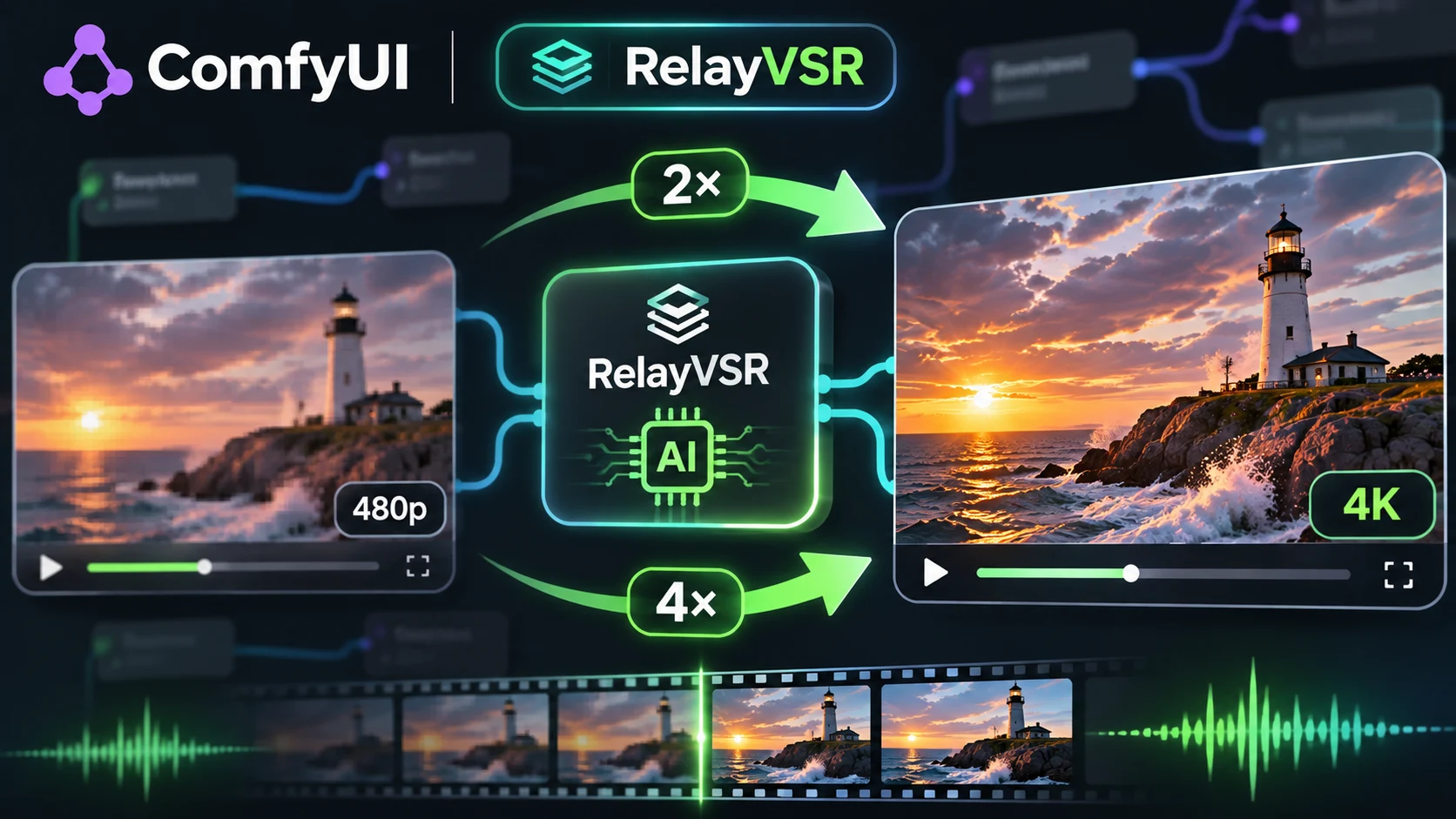
ComfyUI merged RelayVSR support into its main repository on November 5, 2026. RelayVSR is a video super-resolution approach that uses an image-generation-style model on selected frames and a smaller decoder to reconstruct intervening video frames. The merged contribution identifies two-times and four-times upscaling paths, making the integration relevant to studios that work with lower-resolution video references, cinematic drafts, or marketing clips.
The pull request describes a workflow based on a Wan 2.2 model applied to keyframes, with a lighter per-frame decoder handling the material between them. It adds model detection and configuration, a latent format, conditioning for a low-quality input video, and a dedicated decode path. These are technical components of a processing pipeline, not claims that the result will always preserve motion or detail.
For game production, video super-resolution has a narrow but practical role. It might help a team evaluate how a small reference clip holds up at a higher presentation resolution, or prepare a placeholder cinematic for review. It is not a substitute for rendering a game at the correct native resolution. An upscaled gameplay recording cannot recreate interface details or geometry that were never captured, and generated high-frequency detail may drift across frames.
Temporal consistency is especially important around rapid camera movement, particle effects, thin objects, and animated faces. A single still frame can look sharp while the full clip produces flicker, unstable textures, or inconsistent silhouettes. These problems are easy to miss in screenshots. Developers should therefore compare videos at their intended playback speed and examine several representative motion sequences before deciding whether a processed clip is suitable for publication.
A useful experiment would start with a five-second camera flythrough exported from Unreal Engine or Unity at a deliberately reduced resolution. Process it with the RelayVSR workflow and compare the result with a separate native high-resolution render of the same scene. Measure processing time, VRAM use, total file size, and visual stability across frame boundaries. Keep the native render as the reference, rather than assuming that additional pixels automatically mean greater fidelity.
The confirmed news is a merged ComfyUI contribution, not a guaranteed packaged stable release or a benchmark. The pull request also points to model files and related dependencies that users need to obtain and configure. Anyone testing this workflow should first verify the current documentation, software versions, model terms and available GPU memory.
Rate this story
What did you think of this article?
Log in to rate this story, comment and like replies.
Log inNo comments yet. Be the first to share your thoughts.
More stories
Claude Code Adds Background MCP Tasks and Tighter Agent Permission Controls
Anthropic’s Claude Code 2.1.319 introduced asynchronous MCP tasks and new permission controls. These features may help game developers manage long-running Unreal or Unity tool operations without blocking every agent step.
Codex CLI 0.167.2 Changes Incremental Tool Updates on Vertex AI
OpenAI released Codex CLI 0.167.2 with incremental tool updates enabled by default for Google Cloud Vertex AI. The change is relevant to teams using that backend, but it is not a general Unreal or Unity agent feature.
ElevenLabs Previews Interaction Engine for More Natural Voice Agent Timing
At its New York summit, ElevenLabs previewed an Interaction Engine that manages turn-taking, interruptions and model selection in conversations. Real-time game NPC use remains a proposed application, not a shipped game integration.
Comments