
ComfyUI Developer Proposes Adaptive Quantization Under VRAM Pressure
A November 9 draft pull request explores changing model quantization dynamically as VRAM becomes constrained. The experiment is not merged or released, but it raises a useful question for creators using limited-memory GPUs.
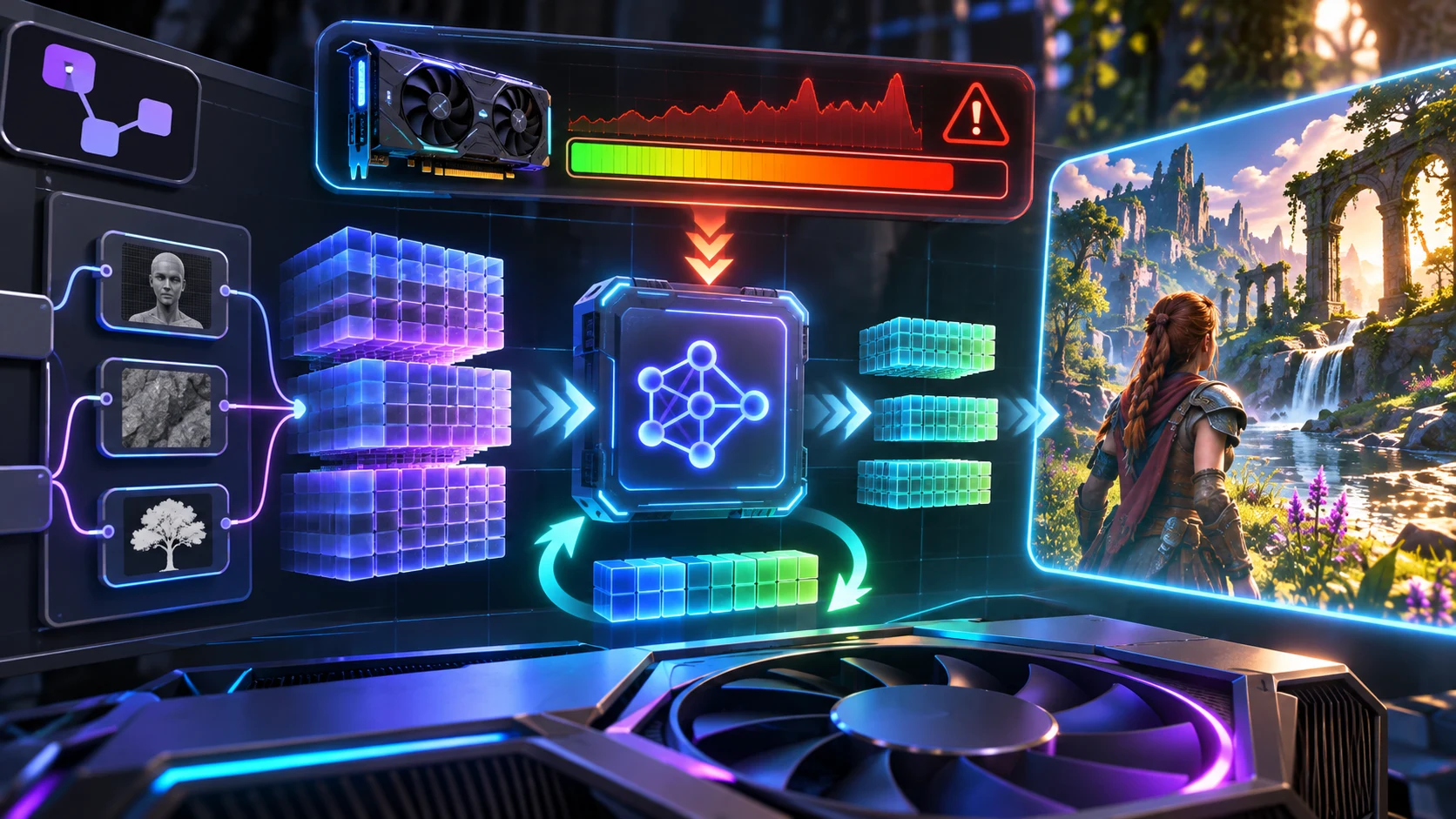
GPU memory is a major constraint in local AI art pipelines. A model that works when started alone may fail after other workloads have consumed VRAM, while reducing precision permanently can sacrifice detail even when more memory is available. A draft ComfyUI development proposal opened on November 9 explores an adaptive approach to this trade-off.
The proposal, titled Support adaptive quantization under VRAM pressure, describes model weights that can step down to lower-precision representations as memory pressure increases. Its author initially targets feed-forward components of a particular Qwen model configuration, with higher-precision codebooks designed to be reducible to lower-precision versions. The goal is a single model file able to adjust some memory use according to available resources.
The developer explicitly notes a trade-off: the effective weights become dependent on available VRAM, so identical prompts may not always produce identical results if quantization changes between runs. That is important for production asset generation, where teams may need repeatable outputs for review, debugging or comparisons. It is also why the proposal should not be described as a free performance upgrade.
As of the reviewed November 9 state, the pull request is marked Draft. It is therefore not a released feature of ComfyUI, and no supported installation method or reliable benefit for common image-generation models has been established in this report. The targeted model described in the proposal is not automatically relevant to every text-to-image, video or 3D model used in a game-art pipeline.
For developers with limited VRAM, the practical lesson is to keep an accurate record of which workflows already fit. Measure peak memory, model loading behavior, processing time and output consistency using a fixed batch of representative prompts. If an adaptive-precision implementation later becomes a supported feature, compare those same measurements under controlled memory pressure rather than expecting gains from a draft design alone.
The November 9 news is that an experimental approach has been proposed in the official repository. It is worth watching because of its potential effect on local hardware budgets, but it remains research and development work, not a capability that current ComfyUI users can count on in a stable release.
Rate this story
What did you think of this article?
Log in to rate this story, comment and like replies.
Log inNo comments yet. Be the first to share your thoughts.
More stories
Claude Code Adds Background MCP Tasks and Tighter Agent Permission Controls
Anthropic’s Claude Code 2.1.319 introduced asynchronous MCP tasks and new permission controls. These features may help game developers manage long-running Unreal or Unity tool operations without blocking every agent step.
Codex CLI 0.167.2 Changes Incremental Tool Updates on Vertex AI
OpenAI released Codex CLI 0.167.2 with incremental tool updates enabled by default for Google Cloud Vertex AI. The change is relevant to teams using that backend, but it is not a general Unreal or Unity agent feature.

ElevenLabs Previews Interaction Engine for More Natural Voice Agent Timing
At its New York summit, ElevenLabs previewed an Interaction Engine that manages turn-taking, interruptions and model selection in conversations. Real-time game NPC use remains a proposed application, not a shipped game integration.
Comments