
ComfyUI Adds Kling 4.0 Flash and Original Audio Controls
ComfyUI merged new Kling partner-node options on November 6, including the Flash video model and an original-audio option for Kling 4.0 workflows. The integration is best evaluated for game trailers and cinematic prototypes, not in-engine runtime generation.
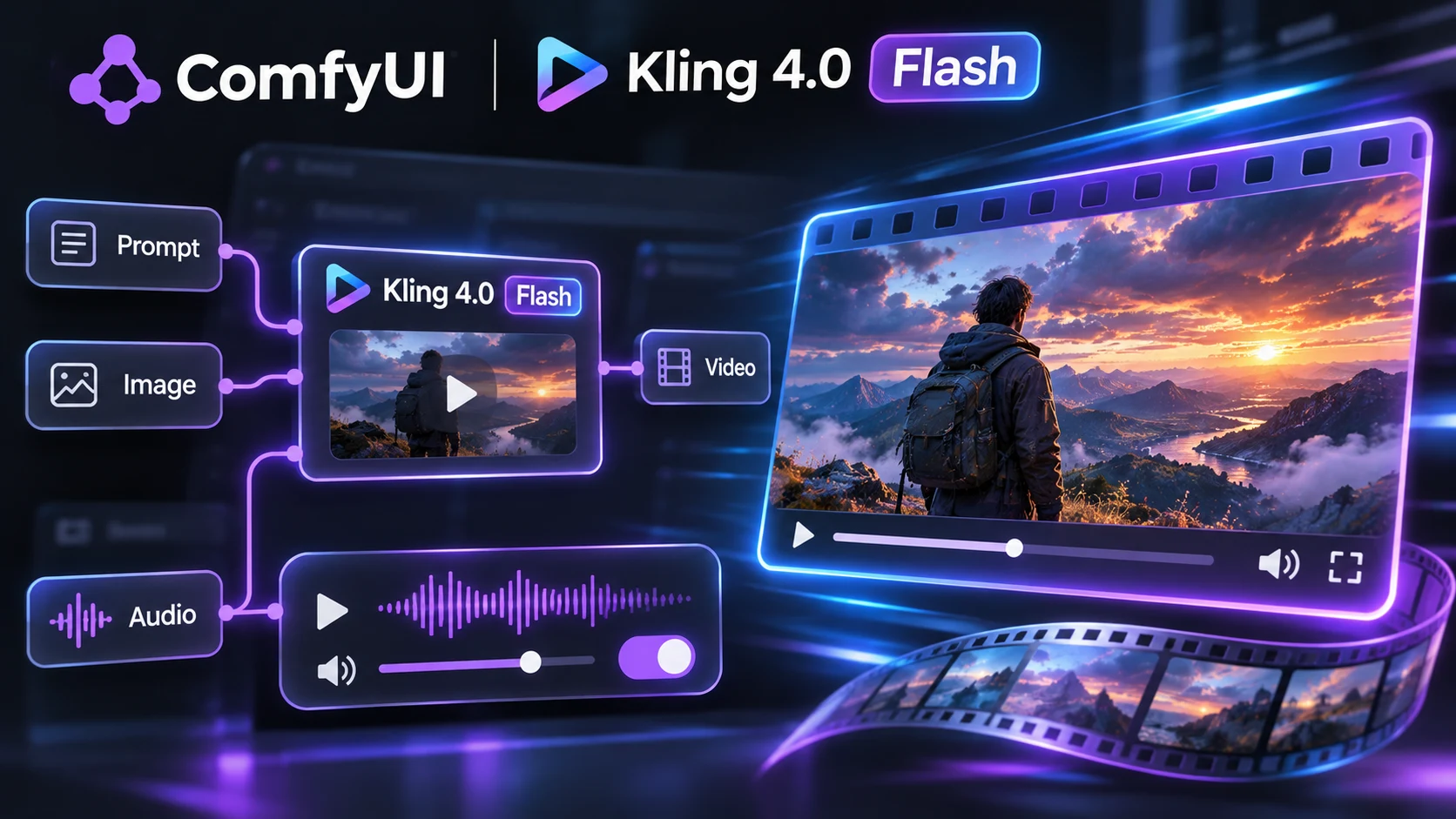
A change merged into ComfyUI's main codebase on November 6, 2026, adds Kling 4.0 Flash and an option related to original audio in Kling 4.0 partner nodes. The update concerns integration with an external video-generation provider. It is not the release of a new video renderer in Unreal Engine or Unity, and it does not mean game engines can generate these clips inside a running game.
Partner nodes make external generation services accessible through a node-based creative workflow. For a game studio, that can be useful when producing early cinematic references, mood experiments, storyboards, or alternative compositions for a marketing trailer. The ability to choose a different model variant changes how a workflow is configured, while audio-related controls create another parameter for a creator to inspect. The exact behavior, cost, and provider rights should be checked in the current service documentation before relying on the output commercially.
The pull request is specific evidence of an implementation being merged. It is weaker evidence for claims about output quality, speed, or public availability. Model names may appear in code before a particular hosted service, account tier, or packaged application exposes them to every user. Likewise, a feature labeled original audio should not be confused with a full sound-design system or guaranteed synchronization for interactive events.
Unreal Engine and Unity users should treat generated video as external media until there is a deliberate integration plan. A short atmospheric sequence can help communicate a level's mood to collaborators; a generated shot can also expose ideas for lighting or camera movement. But it does not provide reusable gameplay animation curves, collision-ready meshes, or a character rig. Converting a visual concept into production content still requires technical work.
A practical test would use a ten-second concept for a game trailer: a fixed environment description, a character silhouette and a simple camera movement. Generate two variations with clear labeling of the model option and audio setting, then record duration, aspect ratio, visible inconsistencies, processing cost, and the terms under which the output can be published. If the result is later imported into a game as a pre-rendered clip, test video decoding and file size independently.
The verified milestone is a ComfyUI source-code merge on November 6. Developers should confirm their installed ComfyUI version and partner-node access before expecting the new controls to appear.
Rate this story
What did you think of this article?
Log in to rate this story, comment and like replies.
Log inNo comments yet. Be the first to share your thoughts.
More stories
Claude Code Adds Background MCP Tasks and Tighter Agent Permission Controls
Anthropic’s Claude Code 2.1.319 introduced asynchronous MCP tasks and new permission controls. These features may help game developers manage long-running Unreal or Unity tool operations without blocking every agent step.
Codex CLI 0.167.2 Changes Incremental Tool Updates on Vertex AI
OpenAI released Codex CLI 0.167.2 with incremental tool updates enabled by default for Google Cloud Vertex AI. The change is relevant to teams using that backend, but it is not a general Unreal or Unity agent feature.
ElevenLabs Previews Interaction Engine for More Natural Voice Agent Timing
At its New York summit, ElevenLabs previewed an Interaction Engine that manages turn-taking, interruptions and model selection in conversations. Real-time game NPC use remains a proposed application, not a shipped game integration.
Comments