
New Community Toolkit Packages Epic’s Game Animation Sample as a Reusable Plugin
A tutorial published October 29 presents a community-built process for converting the Game Animation Sample into an updateable Unreal Engine 5.8 plugin, with configuration safeguards and backup steps designed for existing projects.

Epic's Game Animation Sample can be valuable reference material for developers exploring responsive locomotion and animation design. Integrating a large sample into an existing game, however, is different from opening it as a standalone demonstration. A newly published community tutorial explores one method for turning that example into a reusable plugin.
The October 29, 2026 tutorial introduces an open-source Game Animation Sample Plugin Toolkit for Unreal Engine 5.8. Its stated workflow begins with obtaining the original sample from Fab. The toolkit then packages the material locally as a plugin that can be installed in an existing project and updated later.
The distinction between local packaging and redistribution is important. The tutorial describes a process that does not redistribute Epic's original sample assets. Users obtain the relevant content through the appropriate channel and assemble their own local integration. Developers should still follow the sample's applicable terms rather than assuming that any content included in a plugin is automatically available for public redistribution.
The author also emphasizes operational safeguards. The toolkit is described as providing PowerShell automation, configuration integration, a dry-run validation stage, backups, rollback protection, and preservation of existing project settings. Those are relevant features because adding an animation framework can affect project configuration and input or gameplay assumptions beyond the visible animation assets.
Consider a game that already contains custom locomotion logic, character Blueprints, and an established folder structure. Replacing those systems with a sample wholesale would create unnecessary risk. A reusable plugin approach offers a possible boundary between reference functionality and game-specific implementation, provided dependencies and required project settings are clearly understood.
A careful trial would start with a copy of an Unreal Engine 5.8 project. The developer could run the toolkit's proposed dry-run step, inspect the planned changes, then integrate the plugin and test a single character. A second pass should verify whether the operation can be rolled back cleanly and whether a subsequent update preserves local configuration.
The result should also be tested in a packaged build, not only in the editor. Animation assets may appear correct in a preview while required modules, references, or other dependencies behave differently in a standalone build. Recording those dependencies turns the experiment into something another team member can repeat.
This is a community tutorial and a third-party toolkit, not a newly introduced feature of Unreal Engine itself. Its broader lesson is practical: large official samples become more useful when teams can integrate them incrementally, track what changed, and retain a reliable path back to a working project.
Rate this story
What did you think of this article?
Log in to rate this story, comment and like replies.
Log inNo comments yet. Be the first to share your thoughts.
More stories

An Open-Source Fab Downloader Targets Custom Unreal Engine Workflows
A new community-built Fab Downloader offers another way to retrieve marketplace assets already owned by a developer. Its Windows and Linux tools avoid requiring an installed Launcher-managed Unreal Engine build, but rely on unofficial endpoints.

Epic Extends a Live Verse Virtual Machine Test for UEFN Islands
Epic started a temporary Verse virtual-machine test on October 29 across public and private UEFN sessions and later extended the window into October 30. The test is limited to Fortnite creation tools, not regular Unreal Engine projects.
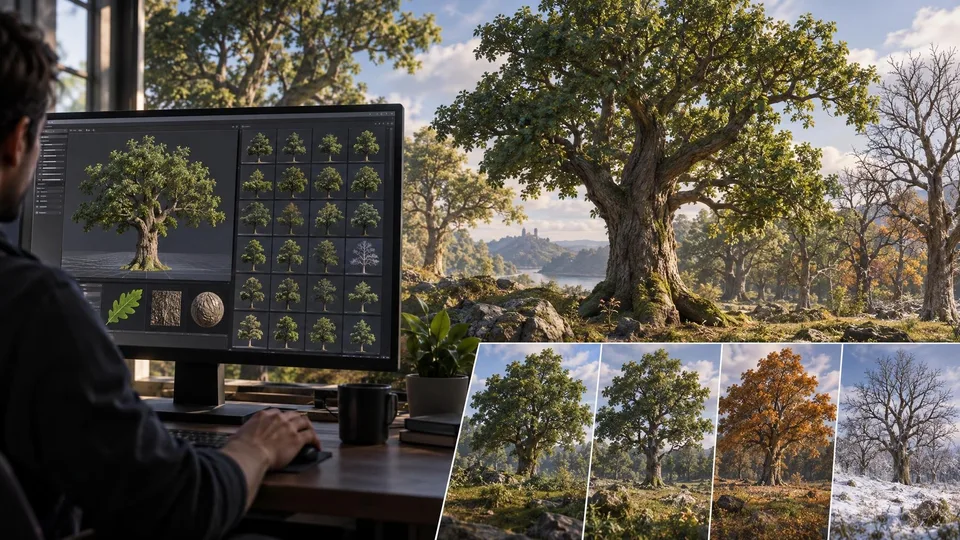
New Procedural Oak Asset Pack Offers 52 Unreal Engine 5.8 Tree Variants
Greenleaf Vision has introduced an English oak preset collection for Unreal Engine 5.8’s experimental Procedural Vegetation Editor. The creator lists 52 variants based on terrestrial laser scans, with custom leaves and bark.
Comments